Sunday, August 11, 2013

The street history of painting


Robert Motherwell  


David Reed

[Images found on the Web; artists and/or his legal representatives hold the copyright; used here solely for purposes of commentary, i.e., non-commercial]


Great quote by artist David Reed in this week's Village Voice:  "It amazes me that in New York there's a history that painters know, a street history of painting, that is totally different from the history that the museums know and the history that is written about in books."    (Click here for entire article; click here for more on Reed).

An insight well worth contemplating and exploring...Reed's own essays on painting (I especially like his memoiristic piece on Rubens in Las Vegas) remind us how relatively few visual artists write much about their work or that of others, the occasional manifesto aside (and who issues manifestos these days?)...reminds me of Motherwell's body of written work, another exception to the rule...

Reminds me also why the interviews in magazines such as BOMB and Turps Banana are so important: conducted by and with visual artists, these conversations form the internal archive containing the alternative "street history" of painting.

Sunday, August 4, 2013

Braking for beauty (slow down and see)


Turner, Chichester Canal (c. 1828; in the Tate)

Jennifer L. Roberts (Professor of History of Art and Architecture at Harvard ) recommends that we "decelerate," deploy "strategic patience," and thereby better understand the world around us through close, unwavering scrutiny.  (Click here and here for more). 

The lobster and the canary could not agree more with Professor Roberts.  We've written at length about "the artisanal turn," the need to restore craft, the tactile, the tacit to our work and play (click here) -- the deep patience required to visualize, to shape, to enjoy, to be satisfied.  Decelerated education, Slow Food, DIY, hand-made this and organic that...they are all of a piece with the braking for beauty.  

Above all, to highlight Roberts's insight, we need to engage with what we see, and to do that we need to look, focus, look.  Fall upward into the painting, let the frame expand and disappear, travel with the collier on the canal, listen to the warblers in the bankside reeds, savor the sunlight reflected from cloud and rill...

Sunday, July 28, 2013

Lisa Occhipinti: The Book Re-Envisioned and Restored


Lisa Occhipinti
[As always, all images and the objects they depict are copyrighted to the artist and/or his/her legal representatives.  Images are displayed here purely for purposes of commentary, i.e., no commercial use.]

The book is dead, long live the book!   I love Lisa Occhipinti's work:  she is hacking (both literally and figuratively) volumes, re-imagining the form and contents, helping us re-see one of our most treasured achievements.  


Portraits (her term) of our books, in their formal moments but also as candids, with all the dignity, humor and pathos of people...which, in essence, they are.  

For more about Lisa Occhipinti and her work, click here  and  here .  And also here.

Sunday, July 21, 2013

Still too hot


The heat and humidity intensified this week in NYC...it is just too hot (canary feathers singed and drooping) and humid (even lobsters need to breathe) to do more than seek shelter under a tree and take a nap...synapses running syrupy, thoughts meandering into a hazy mist or baked slowly under the opaque sky...

Sunday, July 14, 2013

Never too hot for art


Raqib Shaw, Adam (2008)

For more of his work, click here.    And here.

The dog days of summer came early this year in New York City, so the Lobster & Canary seek to cool our sweltering heads with the beauty of art.   The sun and the humidity smothering our analytical faculties, we surrender to the sheer primal love of design, color, the luscious line, the idea so weird it knocks your elbow off the table.


Pawel Bownik, "Reconstructed Flowers" (2013)

For more of his work, click here.


Natvar Bhavsar

For more of Bhavsar's work, click here.  

[As always, copyright in all images displayed here is held by the artist and/or his legal representative(s); images used here solely for purposes of commentary, not for commercial gain.]

Sunday, July 7, 2013

Slantwise across the sky


Sarah Charlesworth, one of the pioneers in Conceptual Art, died two weeks ago.

The Lobster and the Canary are fascinated by her slantwise approach to the world, the way she excised elements to create a new set of objects, a sculptor of images carving away the surface to get to the core.  She helped teach us to see the shadow-lines as the most important vectors, to see the negative space as the essence of the volume, to read a new story into and behind the narrative distracting us with its bombast.


Arguably her most famous work is Arc of Total Eclipse, February 26, 1979, partially reproduced here.  She photographed the front page of c. 20 separate newspapers in the Pacific Northwest as each recorded the eclipse, and then she eliminated all but the mastheads and the photographs, resulting in an eccentric document of the sun's passage across the region and into Canada.   The newspapers did not all use the same photographs, so the event becomes even more singular.   There is no standard, straight-on, transparent story here.   We all see the same things-- even the greatest of natural phenomena--in our own ways.


Click here and here for more.  As always, the artist and/or her representatives hold copyright in the images displayed here (I believe the Whitney in NYC holds the original work).   All images downloaded from public web sites, for non-commercial use and for purposes of commentary only.


Sunday, June 30, 2013

A picture is worth how many of whose words? (A small homage to Robert Rauschenberg)


I return often to Rauschenberg's collages and combines, seeing in them the felt but not-yet-written stories that attend my night-thoughts, especially the tales murmured in a locked room, around the corner of a street I have never visited, behind the rustling billboards on weathered walls.


We hear of "painterly prose," but less frequently of whatever its counterpart might be:  "writerly painting," I guess.   I do not mean art that follows or presents a narrative.  I mean art that has no explicit narrative, art that may nonetheless illustrate a story or mood the artist decided to hide from the viewer...or stories the artist expected the viewer to bring to the viewing without any context or hints, no clues or aide-memoires supplied by the artist.


Rauschenberg-- who famously insisted on the right of the creator to define the meaning to be found in whatever he or she created-- is one of the Great Tricksters.  He sets out meaning in glyphs that each of his acolytes will take a lifetime to understand, strewing meaning under the bedclothes, behind the calendar's date-boxes, over the skrim of an umbrella.   Small bones, splinters, teasingly laid down, snares of paint and gypsum chips, wire and a bottle cap found on Bleecker Street...


How did he know the deep grammar of the stories I want to tell, the stories I feel wound around my bones and lurking in my lymphatic system?

[As always, all images used for purposes of commentary, not for any commercial purpose; images found on the Web.]

Sunday, June 23, 2013

In medias res...


Johann Zoffany, Tribuna of the Uffizi (1772-1778)

As we prepare for an ever more cybernetic future, we stumble over boundaries we made for ourselves millennia ago, boundaries between the Real and Unreal, the Quick and the Dead, Art and Nature.  Reality slips our moorings, while we contest its location, its course, and its ballast.


Domenico Remps, Cabinet of Curiosities (1690s)

Like starlings chuckling on the eaves, the ancient arguments continue about the relationship of things to the words we use to describe them.   (As Francis Ponge says in Mute Objects of Expression, we are constantly forced "to accept the challenge that objects offer to language").   Rooks nesting in our chimneys, tossing bits and leaves down the chute, rustle our debates over the power of language to describe, entrap, encircle, capture a reality that forever eludes.

Open-world video game environments, ever-widening sandboxes of virtual reality...meticulous CGI, visual descriptions of that-which-may-or-may-not-be.  Our modern-day wizards creating-- as Barthes puts it of their forebears-- "the effect of the real."  I have seen The Matrix and it is real.  I have inhabited an Avatar on Cameron's Pandora, and I was real.

The old experiment debouches into the ocean of digital magic.  We wield once more the Shield of Achilles, so famously described in the Iliad.   Yet recall Auden's warning about that shield:  "But there on the shining metal/ His hands had put instead/ An artificial wilderness/ And a sky like lead."

P.S.  Inspired partly by these concluding remarks (page 217) in Joanna Stalnaker's The Unfinished Enlightenment: Description in the Age of the Encyclopedia (Cornell University Press, 2010): "...we are at a critical juncture, when literature is no longer being treated as an autonomous category of discourse, and when other fields are borrowing the tools of textual analysis for their own purposes.  From the rhetoric of science to historical epistemology, there is a new awareness that the science and literature of description are inseparable from one another."   

Sunday, June 16, 2013

Camille Alexa: Interview


Camille Alexa is one of the most thoughtful and inventive writers I know.  (If you have not read Alexa, and you like the work of Aimee Bender, Karen Russell, Kij Johnson, Kelly Link...go order Alexa's Push of the Sky right now).   I love her self-description as someone who likes her humor dark and her horror funny.  I love the way she describes her Edwardian house as full of fossils, willow branches, broken shells and other very pretty dead things.  She is as smart, funny and warm in person as her fiction suggests she would be.  For more, click here.  

Lobster & Canary:  

You appear to be comfortable in many different styles and sub-genres; the works in your collection, Push of the Sky (Hadley Rille Books, 2009) range from cowboys-in-space to hunters-in-the-Stone-Age, and everything in between.  In your gleefully idiosyncratic approach, you remind me of "Golden Age" fantasists such as Bradbury, Pohl, Leiber, Laumer, Fletcher Pratt, perhaps with a touch of Vonnegut...are any of these influences on your writing?  And who else has inspired you?

Camille Alexa:


Growing up, I read everything -- and I mean everything -- I could get my hands on. My Norwegian grandmother came to live with us when I was 9 or 10, bringing her enormous SF&F paperback collection with her. I'd like to come off all highbrow and say I loved the Vonnegut and Leiber and Bradbury and Wyndham and Pohl best … but the truth is I consumed with equal delight John Norman's Gor series, Marion Zimmer Bradley's Darkover novels and McCaffrey's Dragonrider stuff and all the random vintage Harlequin romances sharing her shelves.

L & C:

No matter the material setting, even when you situate your plot and characters in deepest space or the farthest future, a fairy tale tone threads its way through the core of your stories.  Even your stylistic flourishes echo the fairy tale's refrains:  the villainous Boss of the droidtown is frequently referred to as "the oldest son of the youngest son of the richest man on Mars"; Earth's far-flung colonists return to the mother-planet, "long after water became more valuable than human blood," when, "long, long after that, there lived a girl"; one of your heroines, kicking the "Fridge-o-mat," to grab a can of "caffeine-rich Zamola" on the way to school, does so "on the day before the day before the end of the world."  Such lines beg to be read aloud!  Do you read fairy tales regularly, do you read them out loud?

CA:

Very perceptive! My father is a folklorist specializing in music and oral tradition, so I'm always thinking about language and the way words flow and repeat and echo. I love reading my work aloud for an audience, though sometimes I get too caught up and cry or laugh at a story in the middle. But yes, I revel in the sensuousness of the spoken word (too much sometimes?) and want an almost musical rhythm to come through even in print, even when it's ringing only inside a reader's skull. I think about urban myth and poetic edda and traditional folksongs, and how repeated phrases and epithets helped the narrative stay memorable and meaningful for both performer and audience. It's not often a conscious thing when I'm writing, but I'm very conscious of this stuff as a component of my storytelling. 

L & C: 

Many of your stories deal explicitly with technology's impact on human life and our ways of living, while comparing our craft with biology and the systems of the natural world.  I especially like this passage in "The Butterfly Assassins":  "What man had not at some point witnessed the mysteries of nature?  The wonders of man-made magicks and even his most complex mechanicals paled in comparison to the inscrutable workings of Earth and Sky and the beasts that dwelled between" (page. 20).  Tell us more, riff on this theme.

CA:

Okay, a riff, but on a personal note: As influenced as my writing is by my father's folkloric background, it's perhaps even more profoundly shaped by my mother's lifelong enthusiasm for natural history. When I was a kid my mom would bring home and repair human skulls from archaeological dig sites, or stop the car in the middle of an abandoned Texas highway to measure the length of a disgustingly enormous insect by the side of the road, or identify an animal by its scat left on a trail during a family camping trip, or noxious weeds by their Latin names. I'm so grateful to her for imbuing me with a sense of perpetual wonder over the natural world, flora and fauna, geology, climate. She was a keen and knowledgeable amateur scientist in the original sense of the term amateur: one who loves a pursuit or study or science outside the context of a profession (I've read that ancient Romans respected amateurs because dedication to a pursuit for love of the thing was more admirable than a mere moneymaking venture -- no clue whether this is true, not having been alive…). I remember an unnusual bird broke its neck flying into our living room window once, and she carefully wrapped the dead animal in cellophane and stuck it in our refrigerator for a while… uhm, maybe even quite a while… until she could get the specimen to the apppropriate expert for evaluation. My parents are just so cool! I can hardly stand it. 

L & C:

You are particularly good at what I would call "the tender meditation," i.e., internal monologues that your characters have about their relationship to others, to the world at large.  "Flying Solo" is a wonderful, moving example of this, yielding insights on what it means to be connected, and how fragile connections are in the midst of emptiness.   Your further thoughts on this theme?

CA:


That's the payoff for me: to be these characters, to live these characters and their situations the way they live them. I often don't even personally agree with my characters' insights or belief systems or goals… but they make sense to me. When I am them, they make sense. And as a writer, I can be a hundred different people in a hundred different stories. As a reader, I can be a thousand. I'm not sure if other writers experience things this way, but you know that feeling you get when you read a great book? That empathy for and anguish over and frustration with everything a character goes through? Writing is like reading, but to the tenth power. It's truly glorious, yo.


L & C:

If you could invite any other artists (of whatever medium, style, genre, period, etc.) to dinner, whom would you choose and why?

CA:


Hmm…Samuel Clemens (a.k.a. Mark Twain), because he must've been a riot (though possibly a frustrating dinner companion); Kij Johnson, because I just read her collection At the Mouth of the River of Bees and practically died from the beauty; and Jane Smiley, because her books blow me away on like a million different levels and I want to hear all about the research she must've done for The Greenlanders. (I guess I'm writer-centric.) Oh, and since this is my happy imaginary world, our dinner is vegetarian.


L & C:

What would you like to see more of and what less of in speculative fiction as the field currently is?

CA:


I like to think the field -- if you want to call speculative fiction a field of its own within the greater sphere of literature -- is as wide and deep as we're willing to make it, or as we're willing to let it be. What does bother me about the field is not at the written end of the equation but at the writer end; the spec fic scene just seems to have devolved into such an unhappy place. More joy, please! And I don't mean in the stories themselves; high body counts, bleak outlooks, and melancholy endings to tragic zombie love-affairs are all awesome. I mean in the writing and the sharing of the writing: less award-stumping, please.  Less desperation, less arcane insider criticism, less hierarchical scrutiny. More joy!  More joy!  More joy!

L & C:

What are you working on now?

CA:


Well, I recently saw the release of my first anthology as editor rather than writer, MASKED MOSAIC: Canadian Super Stories.  It's been thrilling! Co-editor Claude (Lalumiere) was incredible to work with, and we're both so happy with the stories, the authors, the process . . . it makes me giddy just thinking about it. Seriously, I get a smile on my face every time. Other than that, I spent a lot of time writing short fiction last year (it's all dribbling out here and there, places like Ellery Queen's and Alfred Hitchcock's mystery magazines, a boatload of small anthologies, the occasional obscure lit journal), so this year I'll be a grownup and focus on novels again. Watch this space!

Sunday, June 9, 2013

Diego Salazar Gallery Group Show

Deborah A. Mills & Daniel A. Rabuzzi (a.k.a Imps Etc.),
"Changeling Blocks, numbers 4-6: Baba Yaga, Coraline & Friends"  (2013)

The  Diego Salazar Gallery (Long Island City, NYC  http://diegosalazargallery.com/ ) has a brilliant show running through June 15th, eclectic in style and media but unified in its dedication to exquisite execution and attention to beauty.   Lobster & Canary--in a departure from our norm--cannot claim to be an objective observer, since we have a collaborative piece in the show (the first three "changeling blocks," in our "not-quite-right toys" collection) and Deborah has two other pieces of her own also exhibited.  

All of the artists have studios in the building.  Painters, photographers, sculptors, collagists, glassworkers... styles ranging from the purely abstract to the most traditionally figurative...another common thread: a romanticist focus on reverie, a warm meditative spirit pervades the show...whether revealed in subtle arcs and swathes of muted color enclosing a darkness for introspection in the work of  Karen Mastriacovo, or in the gestural work of  Preston Trombly, with its delicate traceries over calm fields, in the surrealistic assemblages of  Caroline Golden (her work has a smile on its lips, even as it tries to keep a straight face!), or the esoterica and occult images of  Ragnar Lagerblad and of  Christian G. Brandner, in the super-saturated mysteries photographed by Steve McCurry or in the precise, intimate compositions of  Robert Badia, small checkered geometries overlaying forms of nostalgia.

Here is a small sampling from among many good things...noting also that the gallery space itself is a work of art (as always, the artists hold the copyright in their works; the images are shown here for purposes of commentary, not for commercial reasons):


Christian G. Brandner, "Painting # 00900" (2010)


Ann Leggett, "Manuel and Mortality" (1996)


Preston Trombly, "Imaginary Landscape with Red Ribbon" (2013)

Sunday, June 2, 2013

Ligature


Joan Snyder, Carmina (1995; oil, acrylic, herbs, cloth on canvas)


Snyder, My Life (1996; oil, straw, velvet, silk, plastic grapes on linen)


Snyder, Antiquarum Lacrimae (2004; acrylic, dried flowers on linen)

All images copyrighted to the artist, Joan Snyder; used here exclusively for purposes of commentary; no commercial use intended.


Struggling always to close the gap between the Me and the World...navigating towards an ever-receding membrane, an endless arc placidly retreating before and behind me...while I try to impress upon the tangent some small token of my Me, of my being, or at least my sentiments...

...pinning a relic or a flower just picked, it matters only that a sliver, a strand, the tiniest wisp is affixed, connected...

...which would mean (if only the world would hold still for just that one quiet moment) that some of me would become and remain part of the world...for every one else, forever...

Monday, May 27, 2013

Who says we cannot dance about architecture?

 Trying to come to grips with Le Corbusier--an on again/off again endeavor of mine for decades--a presence forever looming, like the Chapelle Notre Dame du Haut in Ronchamp, one of my favorite buildings, yet forever unattainable-- but also like so many of his other buildings (realized and not) that leave me cold--the cavalier trajectory of his urban vistas--how I so appreciate what he wrote and what he painted, the lightness of line and all that emphatic certitude, while so mistrusting the outcomes of his architecture--admiration mixed with wariness.
 Regardless, what most intrigues are his polymathic means to singular goals-- starting with his self-declared alias (a mask that lays bare?), and the oft-remarked fact that, when he gained French citizenship, he entered "homme de lettres" as his occupation on his identity card/passport.  


A belletrist then, a self-declared citizen of the Republic of Letters...to encompass all else, or at least to order the others: the architect, the painter, the designer, the one who sketches.


Two months before he died, in his final interview, Le Corbusier said: “...not being able to build certain things, I could draw them; but not being able to explain them entirely in drawing, especially when it came to urbanism, I had to explain them, so I wrote.”


So maybe we can actually dance about architecture...


Sunday, May 19, 2013

Unique Gestures, Already Pre-Determined


Johannes Vermeer, Lady In Blue Reading A Letter (c. 1662-'65)

I am fascinated by the emerging field of Big Data, and the data mining/analysis that proceeds from the ever larger sets of statistics we gather.  Just when you think you are truly individualistic, you discover that you are but one point on a curve, acting in accordance with the laws of large crowds.  Disconcerting.

How to reconcile the individual and our preciously random actions, with the story told by the trends plotted across millions and now billions of us?

The private and personal, of import only to the reader and the writer (what is the Lady thinking?), juxtaposed with the geometries of collection and the analytics of abstraction (the map on the wall was Big Data in Vermeer's time).

Something I muse on... more to come in future blog posts...

Sunday, May 12, 2013

Upon repeated visits...


Mary Cassatt, Five O'Clock Tea (1880)

I return to paintings, the way I revisit a favorite novel, or order the same dish at a specific restaurant: with anticipation of acquaintance spiced by the knowledge that I will discover something new.

Recently, as I gaze at Cassatt's tea drinkers, I find myself examining the pattern of the upholstery.   I also notice more than before the vase in the painting hanging over the mantlepiece.

When I next look at the picture, what other nuance might strike me?

Sunday, April 28, 2013

Wayside gems: Megan Cump at Station Independent Projects (LES, NYC)


Megan Cump, Black Moon, installation view, at Station Independent Projects (NYC)


Cump, untitled (fox)


Cump, untitled (white deer)
[All images copyrighted to Megan Cump; non-commercial use intended here]


One of the many joys of New York City is coming upon gems in the less frequented byways.   This morning I came across a lovely small gallery--Station Independent Projects-- nestled among apartment buildings on Suffolk Street just below Houston on the Lower East Side.

Inside, perfectly arranged and curated, is a show called Black Moon by Megan Cump.  The individual images are mesmerizing, and the overall effect leaves one with the sense of having been someplace else, a place you cannot quite remember, while you stand blinking on the side of the road at dawn.

For more on the gallery, click here.    For more on Cump, click here.

Sunday, April 21, 2013

Boston: The Polis Unbowed, Undaunted


The "Sacred Cod" That Hangs in the House of Representatives in the Massachusetts State House, in Boston

This week's horror in Boston momentarily stilled our tongue and bruised our carapace, so the Lobster & Canary will be brief.

One thought only: 

The bombs went off right on the doorstep of Old South Church, whose congregation has played a mighty role in the forming of American liberty.  Samuel Sewall was a member, he who wrote the first abolitionist tract, and so was Phyllis Wheatley, and Benjamin Franklin's family. 

The bombs exploded across from the Boston Public Library, the first municipal library in this country, the first to allow patrons to borrow books (and not simply read them on the premises).

The bombs scorched Copley Square and Boylston Street...tore at the heart of the modern plaza, the core of the polis...and the citizens and all good members of civil society responded with swift, selfless love for their fellows, for the values heart-drawn from the deep well of our shared civitas, our commonwealth, our city on a hill. 

Sunday, April 14, 2013

Istvan Anhalt's Symphony of Modules


Istvan Anhalt, Symphony of Modules, sample score notation (1967)

Thinking still about Lebbeus Woods and his architectural forms that were never built, and the imagined libraries of Rauzier, the parrot-towers of Vega (see the two previous entries of Lobster & Canary), I offer another example of hypertrophic vision: the never-performed Symphony of Modules by Istvan Anhalt.  John Cage, in 1969, published some of Anhalt's novel formats for scoring the symphony (see above).  

Reportedly, Anhalt expected that an orchestra would need 50 hours of rehearsal before playing the piece's 28 minutes of music.  

Perhaps somewhere an orchestra is tuning up to give the Symphony of Modules its debut...in one of the winged buildings sketched by Woods, while savants listen in remotely, in a pari-colored library deep in the Brazilian rain forest...

For more on Anhalt, click here.


Sunday, April 7, 2013

"The Inexistent Plausible": Parrot Libraries, Toucan Theaters / J.F. Rauzier; Sergio Vega


J. F. Rauzier, Bibliotheques ideales (two from a series, 2012?) [images copyright Rauzier; non-commercial fair use intended here].

Last Sunday we mulled over the legacy of Lebbeus Woods, the visionary architect of spaces that might-be-but-have-not-yet-been-built.  Riffing further on this theme-- the exploration of the Lands Between, sketching out the vedute ideale, limning what Paulo Herkenhoff calls the "inexistent plausible"-- I offer today samples of Rauzier's "hyperphotos."

For more on Rauzier, click here.

...and then we need to join Sergio Vega on his tireless search for what he calls "the edenic stage," the strange paradise at the heart of an ambiguity just beyond the next curve in the boulevard, proclaimed with buoyant charm on travel brochures and the facings of airline tickets.


Vega, Banana Building (date?)  [Image copyright Vega; non-commercial fair use intended here}

As Vega puts matters during his quest:

"It seems plausible that the next trend in architecture will openly embrace shamanistic strategies. After all, it has already done it in a somewhat restrained manner. In the near future we may come to see a bizarre array of organic buildings acquiring the status of natural specimens. Parrot color-chart architecture, banana institutional buildings, pineapple churches, crocodilian houses, snake promenades, toucan theaters, orchid subway stations, etc. If in the process, all species end up being represented, cities could become entire inventories of the natural kingdom and the whole of the modern world a monumental paradise."

For more by Vega, click here.

Sunday, March 31, 2013

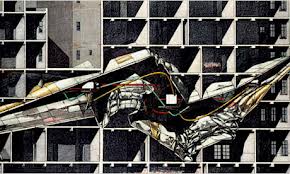
"...if we were free of conventional limits": The Legacy of Lebbeus Woods


Lebbeus Woods, Quake City (1995).

Contemplating and exploring the worlds envisioned by Lebbeus Woods, whose death last October occurred while the lobster & canary were in the grips of Superstorm Sandy here in NYC, i.e., we are still processing his departure and thinking through the impact of the polymathic, iconclastic Woods on art, architecture, urban planning and design.


Woods, Zagreb Free-Zone (c. 2000?)


Woods, Berlin Free-Zone 3-2 (1990)

Very few of his architectural renderings were ever built, though he insisted that they should-- and one day would--be.  A true visionary, who defied convention and walked over boundaries.  

Not enough time or space this morning to delve more deeply, but-- if I had such for a full-length essay--I would think of Woods in terms of other multi-disciplinary, slantwise form-makers: Piranesi, Joseph Michael Gandy, Boullee (The Cenotaph for Newton broods as a possibility over so much of modern architecture), Motherwell, Bontecou, Duchamp, Ernst... Ridley Scott and Giger (Woods is credited with helping them craft the settings for Aliens 3)...

For more on Woods, click here, and here.