Sunday, January 6, 2013

Hair Side, Flesh Side: An Interview with Helen Marshall


Lobster & Canary is proud to present an interview with our fellow ChiZine author, Helen Marshall.  Without further ado:

Lobster & Canary, question 1.  Your debut collection of short stories-- Hair Side, Flesh Side (ChiZine Publications, 2012)-- is extraordinary.  How should we categorize it?  Ruminative horror?  Intellectual horror?  Actually, let's start with "horror," which is a misnomer for what you are doing.  Certainly, horrific images and acts present themselves in your tales, quite memorably indeed.  But the overall effect-- for this reader, at least-- is more subtle, more rarefied even.  We're in the realm rather of the uncanny, the disturbing and unsettling, in the rooms and streets painted by Magritte, in the tableaux created by Ernst in Une semaine de bonte, the collages of Hannah Hoech, or the atmospheres of Leonora Carrington.  Does my statement accord with you?  If not, tell us otherwise.

Helen Marshall:  This is a question I’ve certainly been struggling with (particularly at family dinner parties when I’m called upon to explain what it is that I’m writing—but then again, I think family dinner parties are probably the bane of every writer’s existence!). “Ruminative horror” is a lovely phrase, though whether my stories are horror…I don’t know. I like the idea of horror as the art of going too far (to paraphrase Kim Newman); I like the idea of horror as an emotion. But I think the sort of literary game I try to play is one closer to magic realism in which the characters themselves react to the strange as if it were normal, thereby opening up a space for the reader to feel the “disjunct” between their own expectations and the uncanny. For me, I like the sense of being off-balance. Of breaking the rules. And horror as a “genre”—as something codified—tends to have a rather concrete set of rules for how to scare someone. But I find when you normalize the strange, then suddenly you can cast a new spotlight on what initially seems normal. So the horror of a story like “Blessed” (which you can read here) where a girl is given the body of a dead saint for her seventh birthday isn’t so much in the moment when she discovers the dead body wrapped up special for her, as it is in the ideals of martyring love and self-sacrifice that play out in the girl’s relationship to her mother. The oddity of the world is a kind of sleight of hand that allows me to distract the reader from a deeper game.

2.  Corollary to the above: your work feels much closer in spirit to that of, say, Kelly Link or Aimee Bender, M. Rickert, Karen Russell or Steven Millhauser, than to authors more commonly shelved under "horror" in the bookstore.  "New Weird," "slipstream," "paraspheric"...so many attempts to corral what is inherently a slippery, tricksy creature!   Do you read the authors just named?  Do you feel the kinship?  Here is another one:  as I read your stories, I kept thinking of Vandana Singh's The Woman Who Thought She Was A Planet.  

For about two years the majority of what I was reading (because of my position as Managing Editor at ChiZine Publications) was offbeat horror, so there was certainly an influence there (Cf. David Nickle, Tim Lebbon, Gemma Files, Claude Lalumière and others, but also Neil Gaiman, obviously, and Peter Beagle whom  I adore): it was only when I was in England and I first read Robert Shearman’s collection Love Songs for the Shy and Cynical that I was introduced to a very different style of “genre” writing. For some reason, that kind of writing felt much more natural—perhaps because of my background in poetry where voice and mood are privileged over linearity and plot. But in the rapid phase of reading I’ve done over the last couple of years I’ve found so many writers who I feel kinship with. Kelly Link was one of my instructors at Clarion West, and, God, what can you say about her? She’s one of the smartest, funniest, most insightful people I know. Her writing is brilliant—definitely you can find something of an influence on some of the more recent stories I’ve written. Other people I’ve found I’ve really enjoyed are Dave Eggers, Karin Tidbeck, Johanna Sinisalo, Audrey Niffeneger, Yann Martel, Michael Chabon…well, I could certainly go on. I still find poetry one of my keenest sources of inspiration, particularly for “paraspheric” material (because in poetry, metaphors govern the world and so you never need to ask if something is real or not), and there I’ve fallen in love with Anne Carson, Sandra Kasturi, David Day, Lorna Crozier (my long time love!), Anne Sexton and others.

3.  Uncanny and eerie does not mean, well, nice...in fact, there is a streak of elegant cruelty running through your stories, as hard-edged as that in any authentic fairy tale.  (Again, calls to mind Magritte...and also Bunuel, Kokoschka, Kirchner, Schiele).  How do you balance the cruelty with the love?  How can pain be described in humane ways?

This really puts the finger on where horror comes into my stories (at least in my own head). There are horrible things that happen in my stories, but most of them are the things that are done by people who ostensibly love each other. The reason is simple: it’s easiest to hurt the people we love. It’s easiest to disappoint them. It’s easier to break them a little. To want them to be something they are not. Loving someone is a constant process of tiny injuries. But, at the same time, there’s beauty and there’s kindness and there are moments when selfishness slips away—and the injury is part of that. I think, deep down, I try to find ways to forgive all my characters—that’s both rather daunting and sometimes rather heartbreaking in and of itself. But there’s something glorious and redemptive that comes at the moment in which you say, “Yes, you’ve hurt me, and you’re a little bit broken, and I’m a little bit broken…but there’s something there, and it’s love.” One of my stories that comes to mind is “Dead White Men” (which you can read here)—in which a young man falls for a girl who has the strange power of summoning dead authors to inhabit his body when they have sex. And in the story, Ernie knows that Celia doesn’t love him, she’s just using him for a moment of communion with someone else. But he changes for her, and he becomes a great author himself. And when he dies, she brings him back by use of some other poor soul as a medium. I don’t know if that’s sweet. I don’t know if that’s a happy ending. I don’t know if that’s a sad ending. I don’t know if that’s a cruel ending. It’s just two people bending a little bit more towards each other.

4.  You have a great ear for dialogue, which makes your plots all the more jarring.   You give us seemingly ordinary people, speaking as ordinary folk do, suddenly doing or thinking the most extreme things...what could be more discordant?   Talk about how you use this technique.

I went through a phase where I got very interested in stage plays, particularly the works of Tom Stoppard. (I still contend that Arcadia is one of the most beautiful, heart-breaking plays I’ve ever seen.) Plays tend to work quite differently from stories. In a play, people talk around and around the thing that they are trying to say. In a play, you never mean “I love you” if you say it right off—you mean something else, or you mean it ironically, or you say it as a way to convince the other person it’s true. It establishes a kind of rhythm or patter that’s almost hypnotic, but the more you hear it, the more you start hearing the way people step around things. The refusal to name what they are afraid of. The refusal to ask the question that’s most important because they don’t want to know the answer.
Listen to any of Aaron Sorkin’s dialogue. It repeats and it repeats and it repeats like a kind of litany or call-and-response. But always, always, always the thing that gets repeated is turned on its head in the final act. It’s brilliant! The audience has been lulled into forgetting the thing, the “hook” of the story because it’s repeated so often.
That works extraordinarily well for the kinds of stories I like to tell in which I don’t want to the reader to ask certain questions while they are reading—questions like, “Yes, but why are you giving your daughter the body of Joan of Arc?” or “Why aren’t you reacting with hysteria—or even curiosity—when you discover the lost manuscript of Jane Austen written on the inside of your skin?” Because those questions sort of dismantle that feeling of discord. So Hanna in “Sanditon” asks Gavin about the doctor he’s promised to bring her, but he always deflects her, and she always lets him do it. Because we’re willing to accept deflection from a character like Gavin. Their relationship is entirely about deflection. It works a little bit like a magician’s patter—they speak to draw your attention away from the mechanism of the trick, to lull you, to keep your eyes where they want them. And it means that when you suddenly want a character to speak honestly and directly, it has so much more force. It stops the reader dead because it breaks the patter.


5.  Your work is visceral-- from the title to the sub-titles, from the themes to the images.  Bodies, bones, teeth, skin...  What drives this?

The title Hair Side, Flesh Side came early on, emerging directly out of my work as a medieval book historian. Parchment was quite literally made from the skins of dead sheep and goats, and so one of themes that my adviser, Alexandra Gillespie, returned to again and again in her lectures was the physicality of books. How they were encountered viscerally. And so, the idea of the book as a physical body represented in Chris Roberts’ amazing artwork for the Table of Contents felt like a gorgeous way of bringing that out. People become books in Hair Side, Flesh Side; history becomes a very physical, very tangible thing. And bodies are horrific. They seem like the most stable point of identity, but we know that they aren’t, we know that we have so little control over our bodies but they define us completely. It makes the body a great site to explore the uncanny.


6.  Hunger underlies much of what your characters experience, a hunger for love, a hunger that takes them to the bleak edges of (often forbidden or, at the least, difficult) love, to the potential for pain and a hollow ending.  Talk about the role hunger plays in your fiction.

One of the strongest contrasts I find myself perceiving in the book now is between the very deep hunger that seems to drive the characters and their almost observer-like quality. They aren’t characters who act to pursue their own desires, for the most part; they are characters who get pushed into situations where they seem to deliberately repress their hunger until it threatens to consume them or it manifests itself so profoundly and so physically that it can’t be ignored any longer. I think, on a personal level, I wrote the stories at a time at which I felt very much caught between those two poles; it’s clear to me that “Eternal Things”, in which a young academic meets the ghost of Chaucer comes rather directly out of a sudden loss of intellectual momentum I found in my own research. (This comes, I believe, to most people making the transition into the thesis-writing stage of their dissertation.) But I think it might be more generally reflective of the trouble my generation faces coming, often massively over-educated and loaded with student debt, into a workforce for which there isn’t very much room for us. We all feel hungry to use our skills and to do something, but most of us get sidelined into careers we never quite expected and didn’t train for because we can’t get the career we want. So I think that sense of hunger is maybe a reflection of that kind of dissatisfaction you face as you close in on thirty and realize you’re still a ways off from where you wanted to be: stalled relationships, wrong turns on your career path, all of the things that growing up delivers. But. Even though that carries with it a certain bleakness, I think that there is something redemptive about the stories. People find ways to accommodate the disappointments. To make small steps to move forward. Most of the stories hinge on characters whom have been acted upon coming to make a choice for themselves and taking a new path.

7.  Your most arresting image, stemming in part from the very title of your collection, is that of the word incarnating, the lost work of Jane Austen appearing inside the body of your heroine, unspooling as she starts to flay herself.  A Borgesian turn, a nod to Bradbury's Illustrated Man,  Vinculus in Jonathan Strange & Mr. Norrell, who has the "King's Letters" inscribed on his body as an infant and becomes a living book... As a deep, devout reader and writer, do you sometimes feel that we have literally become the texts we love?  

Of course! I think the stories we tell ourselves shape us very deeply. And one of the things you find about growing older is how much your decisions get inscribed on your body, whether it's pregnancy stretch marks or old injuries which never quite heal properly. When I was young I thought I could, essentially, make myself anew whenever I wanted to. But the older you get, the more you discover that identity isn’t really as malleable as you want it to be; you carry things with you for a long time. One of my earliest stories (never published) was about a kid whom Lucifer fashions to be a repository for his sins, so that he doesn’t need to carry them around with him anymore. And that’s an idea as old as the mark God leaves on Cain so that all will recognize and know his story simply by looking at him. And it was certainly something I struggled with as an editor: getting filled up with other people’s stories when you are trying to come up with something of your own. That’s what Hanna’s up against in “Sanditon”. But it’s also what Gavin’s up against as well—he wants to publish the material, but suddenly he’s in a position where he’s become famous for discovering someone else’s book even though he’s quite a good novelist in his own right. As writers, we all live in the shadow of other people’s work. That’s both terribly wonderful and terribly daunting. And, mostly, you just deal with it by eventually saying, “Well, f*ck it, I’m going to write this story anyway.”

8.  As a deep, devout reader and writer...one who is an editor and works in publishing...what most excites you about fiction as we move into 2013, what most disappoints?

Everything about the fiction itself excites me. Everything! I still have these wonderful moments when I pick up a new book and I think, “Yeah, that’s why we are all doing this! Because people are out there making some kind of magic happening.” Right now, there are some of the most vibrant literary communities managing to thrive, many of them centred around small presses like ChiZine Publications or Small Beer Press—people who are out there taking a tremendous risk and doing a ridiculous amount of work because they think it is work worth doing. There’s a lot of bravery in the industry; there’s also a lot of fear. All I can wish for 2013 is that fortune favours the brave…

9.  If you could ask any artists (living or dead, working in whatever genre, medium, style, etc.) to dinner, whom would you ask, and why?

Neil Gaiman, dead. But only recently dead. I think he’d have a heck of a perspective on what you might find on the other side; I’m not sure there’s anyone better suited right now to be a literary psychopomp…

(Too far dead, though, and I think the smell would probably put me off my appetite…)

10.  What are you working on now, and when can we expect to see it in print?

I’m currently working on a second as-yet-unnamed (or, named-too-often) collection of short stories that will feature some wicked prophesying, a disappearing silk top hat, what lies on the other side of a mother’s bellybutton, a floating bull shark who may or may not be the angel of Death, a very sad can of tomato soup, a telescope that can reveal the past, a phantom thumb, and at least one happy ending. I hope. The first of the stories, “The Hanging Game” will be published on Tor.com some time early 2013. As for the others? They remain in the lap of the gods.

Also, a dissertation on medieval book production in the early fourteenth century. That should be along any day now.

Saturday, December 29, 2012

Enchanting Spaces, Part I: People (Or, The IKEA Catalog as Cousin to The Hobbit)


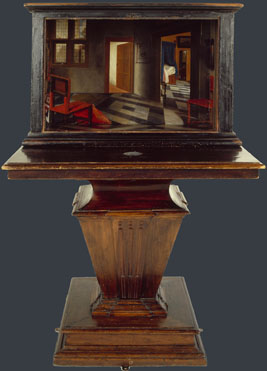
--Samuel van Hoogstraten, Perspective Box With Views of the Interior of Dutch House
c. 1655-'60 (The National Gallery, London)


--van Hoogstraten, Les Paouffles, 1658 (The Louvre)

Who lives in this house?  (I can smell the pannekoeken in the pan, butter browning, with cinnamon...)

Here Bachelard's "poetics of space" meets Tolkien's "elvish craft of Enchantment, the sub-creation of a Secondary World."  Calvino's sixth principle, Visibility, merges with Benjamin's "panoramas, dioramas, cosmoramas...phantasmagorical and fantasmaparastatic experiences, picturesque journeys in a room."


--Ulla von Brandenburg, Mephisto/ Angel/ Krawatten, abgeschnitten, 2010 (installation at The Common Guild, Glasgow)

Who lives here?  (Travelers from afar perhaps, with the heads of dolphins, who speak in hieroglyphics).


--- A Tony Duquette interior, mid-20th-century.

Who lives here?  (A family of connoisseurs I think, with soft velvet paws and eyes that gleam like rubies).

Narnia entered through a wardrobe in a spare room.  The endless battery of rooms and passages that constitutes Gormenghast, the world-castle.  The rooms that mutate, move and cannot be accurately measured in Danielewski's House of Leaves (like Dr. Who's TARDIS, the interior is much larger than the exterior).  Down a rabbit-hole Alice fell, one lined "with cupboards and bookshelves; here and there she saw maps and pictures hung upon pegs."  A hobbit-hole ("and that means comfort"), with its "panelled walls, and floors tiled and carpeted, provided with polished chairs."  The "miniature, perfect Palladian house...with its sweet, retiring melancholy grace" in Angela Carter's "The Courtship of Mr. Lyon."

C

---Anne Hardy, Cipher, 2007

Who lives here?  (A retirement home for Arlecchino and other characters from the Commedia dell'Arte?)

Worlds described within four walls in the novels of Dickens, Proust, Henry James, and Edith Wharton (who made her name first with The Decoration of Houses, published in 1897).  Proust again, on the hotel in Doncieres:  "an assembly of rooms as real as a colony of people."  The famous opening chapter of Balzac's Pere Goriot, describing in the most minute, sociological detail the situation and outfitting of the Maison Vauquer and its peculiar inhabitants ("Nothing can be more depressing than the sight of that sitting room.  The furniture is covered with horse hair woven in alternate dull and glossy stripes.  There is a round table in the middle, with a purplish-red marble top, on which there stands, by way of ornament, the inevitable white china tea-service, covered with a half-effaced gilt network.")  The care with which Mann describes the house of the Buddenbrooks, with which Stefan Zweig recalls elements of architecture in his boyhood Vienna.

Each of us now elvish enchanters in our own small spaces, creating secondary worlds for ourselves.  ("Domestic," with root to "home," filiated with "to build," allied with "domination.")   The IKEA catalog as a cousin to The Hobbit; Pottery Barn, Crate & Barrel, Restoration Hardware... names of realms as potent and perilous as Faerie itself-- maybe these are the latest outposts, in fact, of Faerie on mortal terrain.  Rizzoli and Abrams the names of conjurors akin to Gandalf.  

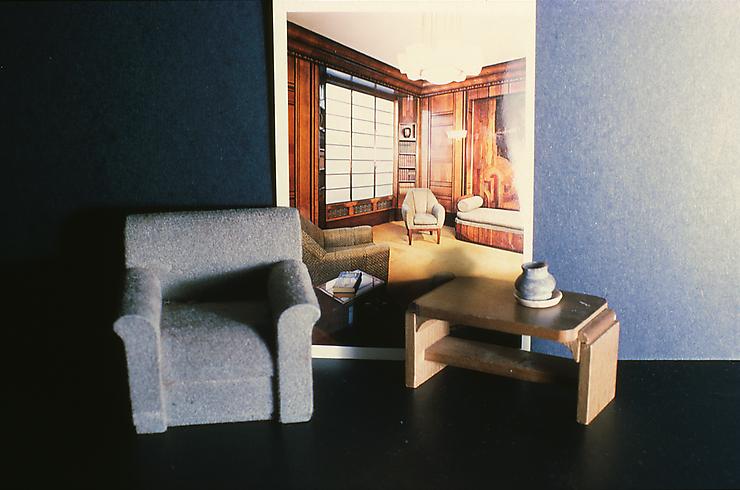
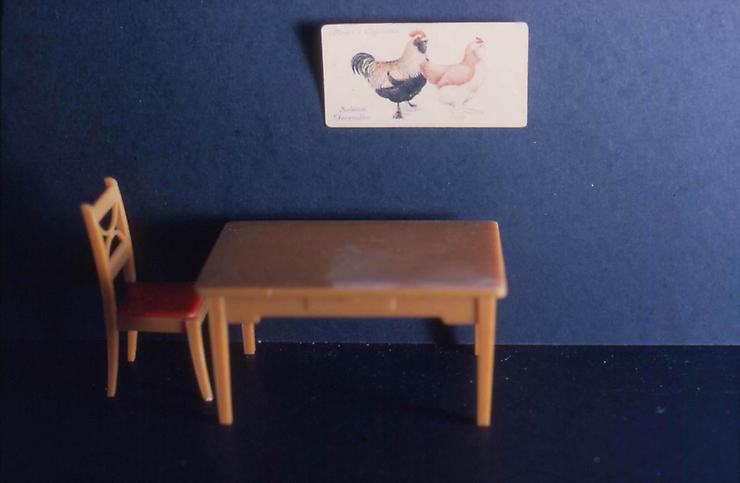
The two images below are by Laurie Simmons, from her Black Series, 1978-'79.

Detail Image

Detail Image

Sunday, December 23, 2012

Painting the Text: Memory's Architecture


Orhan Pamuk realized a remarkable long-time dream in 2012 when he opened in Istanbul his Museum of Innocence-- the physical expression and repository of the story Pamuk tells in his 2009 novel of the same title. 

A museum containing the artifacts described in the novel; a novel based on the objects that epitomize the lives of the characters; a house of fictional memories made real, the fictive as authentic as the reality; the Proustian desire come to life, a mansion of arcades on Sebaldian borderlands.

Pamuk, in an interview with Sameer Rahim, says:  “When people read a novel 600 pages long, six months pass and all they will remember are five pages. They don’t remember the text – instead they remember the sensations the text gives them. In The Museum of Innocence, we are trying to give illustrations to those emotions. The layout of the museum is based on the chapters of the novel: the novel has 83 chapters so the museum has 83 display cabinets, and each box corresponds to the emotion of that chapter.” 

Who can be surprised that Pamuk studied architecture and yearned to be a painter before becoming a writer of fiction?

(Click here and here for more). 

Lobster & Canary wants to take up residence in a museum like this one.  We want to build an annex of our own.  We are apparently not alone in this: over the next week, we'll highlight other artists with similar visions.   Down the rabbit-hole indeed!


Sunday, December 16, 2012

Mervyn Peake, Mannerism, and The Morgan Library

Delighted to say that Garance Coggins references Lobster & Canary in "From Pictures to Prose: How Goya and Rembrandt Contributed to the Titus Books," published this fall in Peake Studies (click here).  Coggins refers to L & C's July 29, 2012 entry, " 'Anything, Seen Without Prejudice, Is Enormous': Mervyn Peake, Caricature, and the Baroque Roots of Modern Fantasy Literature"  (click here).

[Among many insights, Coggins quotes from chapter 14 of Gormenghast, a scene from Bellgrove's class:  "The ink was blue, dark, musty, dirtyish, deep as cruel water at night: what were the other colours?  Titus was surprised at the richness, the variety."]

Along similar lines, for more possible influences on Peake's work (or at least parallel imagery), I recommend a small but powerful exhibition currently at The Morgan Library & Museum in Manhattan:  "Fantasy and Invention: Rosso Fiorentino and Sixteenth-Century Florentine Drawing"  (click here).


Sunday, December 9, 2012

Drop-Time in Hudson Square

Not long ago last week, I strode with purpose around Varick and Greenwich Streets when suddenly I entered the realm I call "Drop-Time": I was alone with multitudes for the long draft between one heartbeat and the next.  (For my definition of "Drop-Time," click here).

I am not sure from whence or how the punctuation sprang, what the trigger was.  A woman glanced at me imperiously as she crossed the street, her thousand-dollar boots stamping the zebra, her scarf as well-combed as her hair.  Two men muttered about advertising rates, three colleagues joked about something as they waited in line at the lunch-truck (which claimed to purvey the world's best grilled cheese sandwiches).  Every storefront a tableau glimpsed, my reflection mingling with the workers inside at the chocolatier's, at the deli, at the bank-that-was-almost-like-a-living-room.  A hundred sharply defined details, a nose here, an eyebrow there, a spoon poised in mid-air between a bowl and a mouth, words, words, words on every surface; the colors of red and teal, maroon, angular black, lots of brick and yellow.  Strips of conversation slid through the air, combined, unknotted, added a coating of words to the muted roar of the trucks on the Holland Tunnel approaches.

In Drop-Time, all those sensations slow into one enormous yet intimate moment, the enjambment between the worlds.  I see everything and hear everything for that one instant, a great diastolic in-rush of sight and sound.  Captured in the poetry of breathing, the flight of words above the reality of the people and places they describe.  I taste the soup on the spoon, I know what is spoken at the truck of the grilled cheese sandwiches, I forgive the woman her arrogance.


Sunbeams frozen on the sidewalks.  Down the side-streets, a diminishing perspective that ends in grey warehouses along the Hudson.  Straitened vision that leads to Gjallar's Bridge with its dim pallor, and the prospect of a ferry across the river towards sunset.

My gaze returns to the world in front of me, the throngs along Varick.  I float for one second with a squadron of pigeons, see all of us below as motes among the buildings.

 
A taxi-driver hits his horn, the light shifts to green, someone yells something into a cell-phone...*blink, blunk*...I am just again inside myself, one among the many, a hyphen nearing my destination.

Carrying within me though the memory and future promise of Drop-Time.


Friday, November 23, 2012

"Then She Fell" (Third Rail Projects)-- Sharing Dreams In A House Big As Memory


Then She Fell literally brings the audience into its spell, involving us not merely as spectators but as participants in a fever-dream meditation on Lewis Carroll, his relationship with Alice, and the nature of Alice herself.   Created and produced by NYC-based troupe Third Rail Projects, Then She Fell entrances, mystifies, surprises, and delights with its immersive, multimedia approach.  Lobster & Canary went through the looking glass a week ago, and recommends the experience.

As Third Rail puts it on a poem they handed out at the end of the two-hour journey (presumably written by a member of the company, as I could not find it otherwise cited anywhere):  "I dreamt that we were dreaming a dream together you and I, and we were trapped in a house, big as memory.  Countless doors."

That house, with its many doors (only to be opened upon instruction or command!), was the artfully laid out basement of the former Greenpoint Hospital in Brooklyn-- the perfect setting for an exploration of Wonderland.  Third Rail takes great pains in its settings, from the flocked floral-pattern wallpaper to the period-perfect handwriting on the patients' records.  For two hours, we were not only in Victorian England, we were actually inside Carroll's world; time outside stopped, inside prismatically fragmented.  Transported utterly by the White Rabbit's timepiece.

While inviting comparison to Punchdrunk's Sleep No More (reviewed by Lobster & Canary on May 1st, 2011-- click here), Then She Fell forges its own innovative way.  Most fundamentally, Then She Fell only brings in 15 audience members per show, and then weaves those members into the show--or, rather, shows, since there are multiple "plot-lines," and no two audience members experience quite the same thing.  We were constantly being split up and re-assembled in the warren of rooms, corridors and other hard-to-define spaces.

Trading nonsensical quips and riddles with the Mad Hatter...ruminating over bits of Carroll's verse, retrieved from a locked box while sitting alone in a tiny room festooned with roses hung upside down...drinking the strangest elixir, offered by one of the two Alices...who then danced with Carroll, after watching herself (the other Alice) in a non-existent mirror...drinking a toast and playing a game with Carroll himself...listening at very close hand to the mournful questions of the Red Queen, spent after her raging, alone at her dressing table...drinking tea at a certain famous party, that got faster and more furious as the gathered actors and guests passed the tea cups...fragments, illusions, hybrid creatures in huge framed pictures, the chilling organization of the hospital trays with their stoppered bottles and large needles, a gramophone that played "The Walrus and the Carpenter" while we surveyed the curious contents of solanders, a hundred aged photographs of Alice, keys, keys and locks...

We've been fans of Third Rail since seeing their Drifting Encyclopedia at the World Financial Center (Battery Park, NYC) in 2010, with its "assemblage of American oddities, scientific & historical ephemera, questionable accounts and implausible representations thereof," and most especially since wandering through their Steampunk Haunted House at the Abrons Art Center (Lower East Side, NYC) in 2011.  We hope that, with Then She Fell, Third Rail gains an even wider audience.  If you are in NYC, go see Then She Fell...and if you are not, call and ask Third Rail to come to wherever you are.

For more on Then She Fell, click here.

For more on Third Rail Projects, click here.   

Banner and photos above are copyright Third Rail Projects (used here from their website, for non-commercial purposes). Pictured are:  Rebekah Morin as the Red Queen and Tom Pearson as the White Rabbit, Alberto Denis as Lewis Carroll and Marissa Nielsen-Pincus as one of the two Alices.  

Sunday, October 28, 2012

The Interstitial Arts Foundation Salon


The Interstitial Arts Foundation held its monthly NYC salon last week, organized and curated by K. Tempest Bradford, and hosted by The Vagabond Cafe in the Village.  Lobster & Canary has happily participated in the salon on other occasions, and was sorry that conflicting commitments kept me from attending this time.  But we had a scout there-- my wife, the artist Deborah Mills, who sends us this report:

"Fabulous conversations with fascinating people, with friends and newcomers alike...truly multifaceted and interdisciplinary (interstitial!) across the board...I spoke with playwrights, lyricists, writers of all sorts, publishers, artists and designers working in many media, and musicians...the venue (The Vagabond Cafe) was warm and welcoming, a perfect place to catch up on all things interstitial while enjoying lovely and affordable food and beverages...this happens every month...I am already looking forward to the next one!"

Hear, hear!   If you are in or around NYC on the third Thursday of every month, please stop by to join the conversation at the IAF salon.   To get the exact date and time, check out the IAF at http://www.interstitialarts.org/wordpress/  (or click here).

For more on The Vagabond Cafe, click here.  

For more about the IAF salon's curator, K. Tempest Bradford, click here.

Sunday, October 21, 2012

Wendy Ellertson at the Javits in NYC


[All images and artwork here are copyrighted to Wendy Ellertson.]

Yesterday, we enjoyed catching up in person with one of our favorite artists, Wendy Ellertson, who is showing this weekend in NYC (Javits Center) at The American Craft Show.

Wendy has brought many new creations to the show.  If you are in NYC today, Lobster & Canary recommends you head to the Javits and find Wendy's booth (# 233, on a corner!).

Each of her pieces comes with a story waiting for its new owner to continue.  Her creatures are shamanic, connecting us with cloud and stars above, and root and rock below.  When I look at  Wendy's people, I am reminded of the Prydain novels, of Earthsea, of Patricia McKillip's tales, of Moominvalley, of Brian Froud paintings and the puppets in Jim Henson's The Dark Crystal and Labyrinth.

Best of all are the textures: the rawhide and worked leather, the feathers and fur, the bits of glass and glimmer.  Wendy's beings live and breathe, they have been caught in mid-stride, on the tip of launching into flight.  They are the visions of a seer, made real.

For more on Wendy, click here for her website and here for her blog.  

Monday, October 8, 2012

The Indigo Pheasant blog tour continues

My blog tour to help launch The Indigo Pheasant continues.   You can read my guest posts here:

September 11:  Small Beer Press/ Not a Journal:  "A Raffle of Laughter on Solemn Occasions."  Click here.    

September 14:  Civilian Reader:  "The Fantastical 18th and 19th Centuries, or, Dragons Dancing at Almack's."  Click here

September 17:  Fantasy Book Critic:  "Go Ahead: Judge These Books By Their Covers."  Click here.

September 18:  Bibliophile Stalker:  "Seeking the Distant Hills Within."  Click here.

September 23:  Layers of Thought:  "A Picture-Show in the Night-Kitchen."  Click here.

[September 24:  That Artsy Reader Girl:  "A History of Wonder: Illustrating Yount."  Click here.   Written and illustrated by my wife and artistic collaborator, Deborah A. Mills].

September 27:  Dark Wolf's Fantasy Reviews:  "Illustrating Yount."  Click here.

September 28:  So Many Precious Books, So Little Time:  [A Give-Away Raffle for The Indigo Pheasant]   Click here.

October 3:  The World in the Satin Bag:  "The Palest of Copies: History, Culture, Empire and Fiction."  Click here.

October 3:  Bull Spec Blog:  "The Hardest Part."  Click here.

October 4:  Charlotte's Library:  "On Writing Historical Fantasy."  Click here

October 5:  The Cozy Reader:  "On Titles."  Click here..

Deborah & I have several more guest-posts to go.  Stay tuned.

Sunday, September 16, 2012

The Indigo Pheasant


At Lobster & Canary, I almost never talk about my own work but I ask your indulgence at this tiding:  yesterday ChiZine Publications (CZP) published in paperback and in all major digital formats my second novel The Indigo Pheasant, the sequel to 2009's The Choir Boats.   (CZP brought out a limited-edition hard cover in July).  Both novels are available world-wide and through all major sales channels.  My wife, the artist Deborah Mills, did the woodcarving that forms the basis for the cover design, and she did all the interior illustrations.

You can take a look at free preview chapters of both novels at the CZP site:

The Choir Boats (vol. 1) - preview chapters

The Indigo Pheasant (vol. 2) - preview chapters.

I will be on hiatus for the next month here at Lobster & Canary...but you can actually read me more frequently than ever in September and October, as I will be guest-posting at the following blogs (publication dates, except for the two already posted, are approximate; I will provide links when posts are up):

September 11:  Small Beer Press/ Not a Journal.   Post:  "A Raffle of Laughter on Solemn Occasions"-- click here.

September 14:  Civilian Reader.  Post:  "The Fantastical 18th and 19th Centuries, or, Dragons Dancing at Almack's"-- click here.

September 17:  Fantasy Book Critic

September 18:  Bibliophile Stalker

September 23:  Layers of Thought

September 24:  That Artsy Reader Girl

September 27:  Dark Wolf's Fantasy Reviews

September 28:  So Many Precious Books, So Little Time

September 30:  Disquieting Visions

October 3:  The World in the Satin Bag

October 4:  Charlotte's Library

October 5:  The Cozy Reader

October 9:  Grasping for the Wind

October 11:  Jess Resides Here 

Sunday, September 9, 2012

Un-Still Life: An Interview with Artist Paula Pertile

Helium Figs, by Paula Pertile (all illustrations used with the artist's permission)

The lobster and the canary are delighted to have artist Paula Pertile as our guest today.  Paula creates some serious whimsy with her colored pencils, the kinds of images that simultaneously amuse and unsettle, that keep you coming back for more.  Trained in architecture at Cal Poly San Luis Obispo and in illustration at the Academy of Art in San Francisco, Paula has done a wide variety of commissions for publishers (she is a leading illustrator of children's books), media companies, major retailers, and greeting card companies.  You can read more about her background and her projects at www.paulapertile.com  

  
Plums Up

Recently Paula began a series she calls "Un-Still Lifes."  Fascinated, the lobster and the canary asked some questions about this captivating exploration of weightlessness and fancy.

L & C:  What was the initial inspiration for this series? 

Paula:  "I had some lovely figs I wanted to draw. I fiddled with them, trying to set up an interesting still life. I had taken several photos, but wasn't really inspired by any of them. Then, in a moment of sheer frustration, I just flipped one upside down and thought 'well, why not?'.  The rest of the composition fell into place after that.  I really didn't have a well thought out idea about making a series, or what to call them, or anything like that. It was just an impulse to do something different. 

I guess the first piece in the series is actually Pulling Up Roots, which I did a while ago. At the time, I just wanted to do something with floating food, but the actual idea of an 'un-still life' hadn't come to me yet.

Calling these 'un-still' came to me after the Helium Figs piece was finished, and that's also when I realized I had unwittingly started a new series."


Pulling Up Roots

L & C:  Why depart from your other style(s) of work? 

P: "Its refreshing to have a new idea that really feels like 'me'. I've done so many nice still lifes of food and other objects that are no different that what a lot of other artists do, and frankly, a little boring. These 'un-still lifes' come from a place in me that gets me excited. I am looking forward to incorporating some architectural elements into them, working larger (and smaller), and just 'going there', if you will."


Taffy Rain
L & C:  What is your technique?

P.: "These pieces have all been done with colored pencils on paper. Colored pencils are my favorite medium, so I plan to do more like this. I mix wax and oil based pencils, and work 'dry', without any solvents.  I would like to explore using graphite, and maybe watercolors at some point, which are both media that I use for other illustration work."

L & C: Is the audience different for the Un-Still Life pieces?  

P.: "These pieces are a continuation of my realistic colored pencil work, but with a twist. They are new, so the audience remains to be seen. I'm guessing it will be people who appreciate classical realistic art, but who also like something just a bit different. As an illustrator, I draw and paint all sorts of subjects (children's picture books, architecture, decorative art, etc.). I expect that the audience for those pictures is quite different than the people who will be attracted to these!"

L & C:  Is there anything else you'd like to share?

P.: "Well, there's a funny story about the Plums Up piece. I conceived that as all the plums rising upward. And all the while I was drawing it, in my mind, that's how I saw it. It never occurred to me that the plums could be falling down, because I was so fixed on them floating up!  When it was finished, I posted it online and asked for help with a title. People came up with things like Plummeting and other clever titles that referred to the plums falling down. Other people said they knew they were supposed to be floating upward, and one finally suggested Plums Up. So I thought it was interesting that the piece could be viewed in different ways!

Summer Pops

P: "Thank you so much for having me as a guest on your blog. It's very encouraging to have people respond positively to these new pieces, and I appreciate the support so much."

L & C:  Our pleasure!  And now you have made us hungry!

Friday, August 31, 2012

The Craft, The Workshop


In recognition of (American) Labor Day, which is celebrated this weekend, Lobster & Canary honors the work, the discipline, the craft that goes into the production of art.

One example: above are pictures from www.jasonwustudio.com, revealing a little bit of the care and artisanal detailing that Jason Wu and his team put into the making of his collections.

The form springs from the mind, the making (with needle or keyboard, paintbrush or mouse, chisel or mallet, pencil or horn, violin or dance-shoe) from the hands and the body, our feet.  From the sweat the sweet.

Saturday, August 18, 2012

Beyond the Loggia, Outside the Garden

Antonello de Messina, Saint Jerome in his Study (1460-'75)

In our genres of speculative fiction--fantasy, science fiction, slipstream, the weird and fabulistic in all their many strokes of invention--we have devised advanced strategies for "world building."  Not to replace or displace the World, but to understand it better, to improve it in some small way by bringing back what we saw and what we learned Beyond the Fields We Know.

I wonder when the urge to travel outside the World first hits those of us who write speculative fiction (or "Fantastika," to use John Clute's term).  For me, the desire has simply always been with me, but I can  pinpoint the first times I thought about the desire, when I recognized its power and began to name it.  I was a boy, less than ten, poring over books full of pictures by European Renaissance painters, captivated by the gorgeousness of oil paint, the lushness of draping fabric and sheen of angel wings, rays of the sun, gilt scrollings, birds brilliantly plumaged, the glory and strangeness of the stories depicted.  But most of all I found myself curious about what might lie beyond the scenes portrayed, by glimpses the painters provided (in a seemingly off-hand or indifferent way) of a world outside the garden (but don't be fooled, the artists poured their souls into the vedute), views that coolly teased and drew me on.

Like Saint Jerome, I sat in my enclosed study, within the order of the World, surrounded by known things and the symbols of known things.  Yet enclosure is no necessary prison; follow Saint Jerome's gaze to the book, as it skips then towards the southwest corner of the picture, and focus on the window set into the wall, beyond which is a landscape.  Oh, there it is...the landscape into which I want to go, forsaking the Book of the World for the Alphabet of the Unknown. 
Antonello de Messina, detail from the painting above

It takes a while to find the way through the window, as the Renaissance painters knew.  First you zoom in too far back, then in too close, losing perspective, seeking to center the road while it evades your feet.

Carlo Crivelli, Annunciation with Saint Emidius (1486)

When you begin to triangulate, to place the way right in front of you, to enlarge the little side window into an open archway, you can find yourself drifting backwards.  After all, it is hard to leave the World, with its endless delights and wonders and stories stranger than water.

 Pinturicchio, The Annunciation (1501)

When at last you center the view and open the window, you begin to approach the outside, you begin to see others out there.  Are they... 

Rogier van der Weyden, St. Luke Draws The Madonna (c. 1440)

...pilgrims like you, or at least dilettantes on an afternoon's picnic excursion...or are they denizens of the Other World, come in close to ours, like dolphins in the surf?  Who built those houses, that bridge, the ship at anchor in the river?

Jan van Eyck, The Madonna of Chancellor Rolin (c. 1435)

Sooner or later you realize that the view itself has changed (perhaps the parti-colored wings of Gabriel have amazed you), something in the air is more lucid yet also more aslant-- look carefully at the scenes under each arch window in de Credi's Annunciation below (each is a slice of a different world, the angles and atmospheres not aligned, the perspectives askew).
Lorenzo de Credi, The Annunciation (c. 1480)

You summon the nerve to come closer, yet still you hover and hesitate on the border, a pear held upside down...

Bernaert van Orley, Madonna with Child (c. 1520)

...a final draft before setting out...(from the Lady who must be floating just outside our window, looking in at us, in our chambers far above the ground)...

Quentin Metsys, Marie-Madeleine (c. 1517)

...and then you are on your way...

Hans Memling, Saint John Altarpiece' detail (1474-'79)

...equipping yourself for the journey... 

Pietro Perugino, The Delivery of the Keys (1481-'82)

...a journey that takes you far away...

Benozzo Gozzoli, Procession of the Magi (1459-'61)

...far away, but not alone, and with knowledge of the path back.

Paul Bril, Imaginary Mountain Landscape (1598)

[As always, no copyright infringement is intended; all images have been located on the Web and are believed to be in the public domain; this is a non-commercial use].

Sunday, August 12, 2012

For Star-Crossed Lovers Everywhere: The Thorn and the Blossom, by Theodora Goss

The Thorn and The Blossom by Theodora Goss (2012 by Quirk Books, with illustrations by Scott McKowen) is a delightful love story, a tale of missed chances and mutual misunderstandings, woven around a thousand-year-old curse by a jealous witch.  Brendan and Evelyn meet cute in a bookshop in Cornwall, but their first kiss ends with Evelyn fleeing from a vision she has of Brendan transforming into the Green Man.      A decade passes before they meet again, fate (?) throwing them together in the English Department of a small college in Virginia.  Their love reignites ("For the first time that she remembered, the world felt right, as it should be.") but then Evelyn learns of Brendan's secret...

Goss--a professor of literature at Boston University--re-imagines in an original way the tale of Sir Gawaine and the  Green Knight, evoking more generally Arthurian legend as glossed by Tennyson and John William Waterhouse (she refers explicitly to Waterhouse's famous 1888 painting The Lady of Shalott).  Goss conjures not only a modern-day love story but the spirit of 19th-century fascination with an idealized medieval world, the world envisioned by Burne-Jones, Dante Gabriel Rossetti and William Morris.  Deeper still, Goss updates the dangers of passions that seem to cross decades and centuries, the chill hazards of romance on the thresholds of death--summoning here a sensibility found in the work of Christina Rossetti, Elizabeth Barrett Browning and Charlotte Mew.  Best of all, Goss leaves some things unexplained, and ends on a note of musing rather than finality.

Goss is already one of the fantasy genre's leading voices, both as a storyteller (she won the World Fantasy Award in 2008; her collection In the Forest of Forgetting from Prime Books in 2006 is a casket of gems) and a scholar (her 2008 study for Aqueduct Press, Voices from Fairyland, should be a standard on syllabi for Victorian poetry).  What she has done now is refresh the genre, expanding its interests into territory explored by A.S. Byatt in Possession and--still further afield--by Nicholas Sparks, Jodi Picoult, Anne Tyler.  Alice Hoffman has shown that there is a large audience for such explorations, as have movies featuring love stories with a paranormal or Borgesian twist such as 1998's Sliding Doors with Gwyneth Paltrow and John Hannah and the 2006 Sandra Bullock/Keanu Reeves vehicle The Lake House.  I hope Goss will continue mapping out her own lanes and fields in this province--and why not a film version in the bargain?.

No review of The Thorn and the Blossom can be complete without mention of its charmingly ingenious construction: the story is told separately from the point of view of each main character; the book is bound accordion-style, so that the reader can start with either "Brendan's Story" or "Evelyn's Story," then flip the volume upside down and backwards to conclude with whichever version of the tale is as yet unread.  Quirk Books has done a masterful job of physical production, from the slipcover to the McKowen illustrations, from the golden ivy and floral scrolling that runs the borders of each page to the embellished lettering on the covers--all worthy of Morris's Kelmscott Press.  The book even smells delicious, which unites the reader near perfectly with the heroine Evelyn:  "Yes, there it was. The intoxicating smell of old books.  It was one of the reasons she'd wanted to study literature rather than attend law school."

FTC-required book reviewer note:  I purchased my copy of The Thorn and the Blossom (for that matter, I bought my own copies of In the Forest of Forgetting and Voices from Fairyland as well); the review above is unsolicited.  

Saturday, August 4, 2012

Sam Smith: Tigers, Harpies, Centaurs And A Packet of Crisps


Sam Smith (1908-1983) created characters of startling personality, based on enduring types (e.g., the Harpy, the Bareback Rider, the Steamboat Captain), showed us small worlds that opened endlessly inwards.

I love most the mood of his settings, which are snapshots of the phantasmagorical made into the reality of everyday: but of course one sees centaurs being ferried across the river on a Tuesday! and parti-colored tigers on parade down main street!


Like all true artists, Smith generates in his audience the urge to create as well--in my case, to create stories based on the whimsical people he sculpted and the eccentric toys he made.  I have for years built narratives around his mock-solemn, gently skewed, brightly lacquered creatures.  His sculptures are vignettes captured mid-stride...but where are they going, and why?
Deborah & I had the great good fortune to see Smith's work at his last major exhibition, at the Serpentine Gallery in London in the winter of 1980-'81.  His vision has never left us since.  

For more on Smith, click here.