Sunday, September 6, 2015

City Dreaming

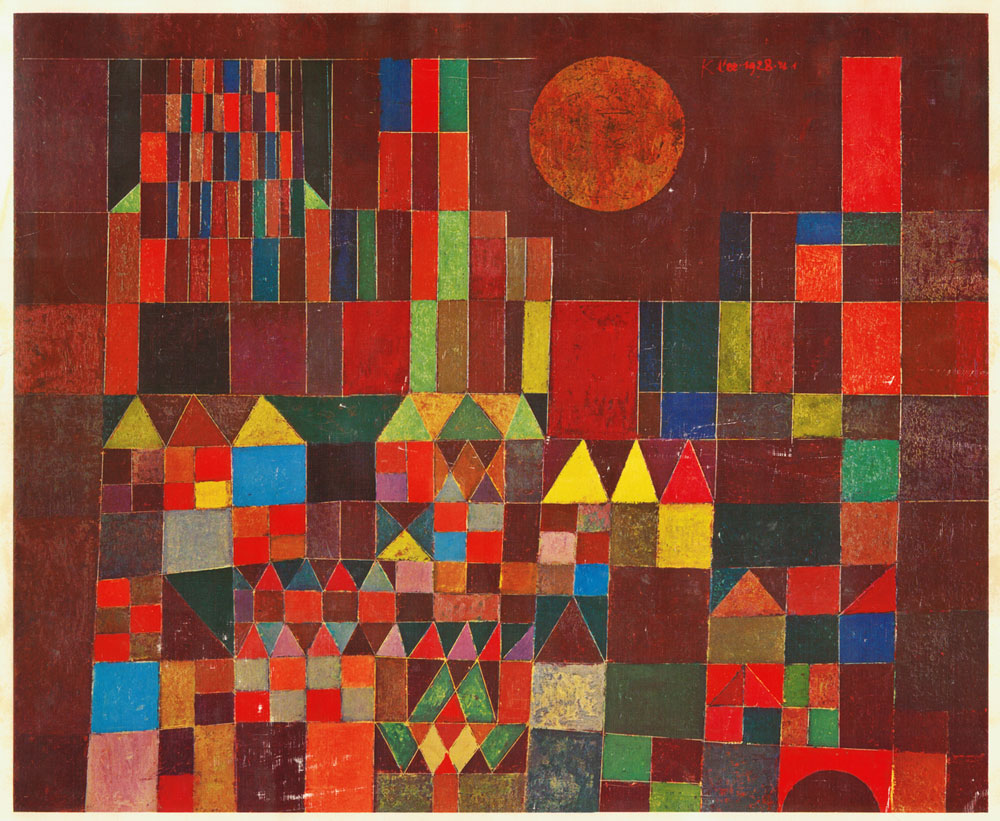
Castle-and-Sun-by-Paul-Klee

Paul Klee, Castle and Sun (1928)


The lobster emerges just long enough from the bottom of the bay to converse with the canary.  

"City lights," says Canary.

"Drinking their reflection," says Lobster.

Daytime work precludes more frequent posting-- and will continue to do so this fall.  You can catch glimpses of the lobster and the canary on Twitter:  @DanielRabuzzi


Elias Sime, The Computer Cemetery - or Addis Ababa as Motherboard (c. 2005?)


In the meantime, slivered recommendations, best of what I read this past year (alas! no time to comment further) in no particular order:   V. E. Schwab,  A Darker Shade of Magic;   Sofia Samatar,   A Stranger in Olondria;  Ann Leckie, Ancillary Justice; Jeff VanderMeer, The Southern Reach trilogy;  Erika Johansen, The Queen of the Tearling; Katherine Addison, The Goblin Emperor;  Diane Setterfield, Bellman & Black; Daniel H. Wilson, Robopocalypse;  Helen Marshall, Hair Side, Flesh Side; Daniel O'Malley, The Rook;  Nathaniel Mackey, From A Broken Bottle Traces of Perfume Still Emanate;  Genevieve Valentine, Mechanique: A Tale of the Circus Tresaulti;  Kathryn Davis, The Thin Place;  Andrew Nicoll, The Good Mayor; Paul Cornell, London Falling.  


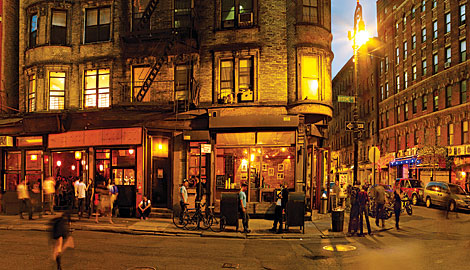
Lower East Side Photo


 Jeff Chien-Hsing Liao, "Lower East Side, NYC, Street Scene" (c. 2014)


And a handful of favorite short stories, some old, some new, that have intoned their magic over me this year:  Steven Erikson's "Goats of Glory" (from the Strahan & Anders anthology, Swords & Dark Magic);  Ellen Kushner & Caroline Stevermer's "The Vital Importance of the Superficial" in Datlow & Windling's Queen Victoria's Book of Spells); and Yoon Ha Lee's "Iseul's Lexicon" from her Conservation of Shadows.


Aleksandr Brodsky & Ilya Utkin, "The Paper Architects," from their Projects (1980-1990)


Sunday, January 4, 2015

Dragon by Da Vinci

Study of Cats and Other Animals c. 1513


Look carefully, there among the cats.

Da Vinci thought hard about dragons--he pondered most of all the proper placement of their wings.  With his superior knowledge of anatomy and physics, he made sure dragon-wings were positioned in the place of arms, rather than appended helicopter-style to the shoulder blades (he drew winged dragons elsewhere; I cannot find the image at the moment).

I require such scientific exactitude in my creatures of fantasy.  

Except when they are bumble bees.

Sunday, November 30, 2014

Kianja Strobert at The Studio Museum Harlem


Kianja Strobert
Untitled, 2011  (Mixed media on paper; 30 × 22 in.;Collection of Zach Feuer)


Kianja Strobert evokes the deep energy, the stop/look/listen to your beating heart, the stillness of the Now.  Immerse yourself in her work, currently exhibited at The Studio Museum Harlem.  

Her own vocabulary, her own identity, with nods to Diebenkorn, Alston, Twombly, Thomas, Frankenthaler, Mitchell.

I especially love the title of her exhibition:  Of This Day In Time.

Brings me into what I call "Drop-Time."   I have summoned the Drop-Time in earlier Lobster & Canary entries:  Drop-Time,"the moment that is frozen in motion, simultaneously gliding and flying while having been lived once, in a specific blink or gasp, months or years or decades ago."


[As always, all images copyrighted to the artist and/or her legal representatives, and/or the photographer; images used here solely for non-commercial purposes of commentary].

Saturday, October 25, 2014

Lock-tight doors and paint-over windows


© Cy Twombly

Cy Twombly, Untitled, 1970. Pencil, plywood, color pencil, oil paint, wax crayon and Scotch Tape

Most mornings-- in the deep pre-dawn-- I drift through landscapes of my mind's devising, listening to my own voice filtered through rock and cloud, reciting poetry in an obscure tongue.

Today, so early it might almost have been last night, I wandered through long corridors, hallways bathed in sepia tones and wisps of palest ruby.  Cryptic scribbles covered the walls-- I kept trying to read what was written, walked on unenlightened.  

Doors everywhere along the roofed avenue, none open, taunting me with their resistance to my efforts.  Windows too, all inked over-- I could hear winds and bird-calls beyond, but the panes remained opaque.

So hard to convey...this Twombly comes closest.

[As always, all images copyrighted to the artist or his/her legal representative, used here solely for non-commercial purposes of commentary].


Sunday, October 5, 2014

Ominous Radiance


Sometimes words wrack me with their power-- I could fall down and drown in them.

This week I collided with Melville's poem "The Berg; A Dream" and have re-read it multiple times, giddy with it, while fearing its danger.

Above all, this ominous radiance:

"Along the spurs of ridges pale,
Not any slenderest shaft and frail,
A prism over glass-green gorges lone,
Toppled; or lace of traceries fine,
Nor pendant drops in grot or mine
Were jarred, when the stunned ship went down."

Sunday, September 21, 2014

Sinister Beauty


Virgil speaks much of bees ("little Romans" he calls them, for their diligence and loyalty) but says nothing at all about wasps-- which is a shame because their biography is at least as illustrious, and frankly more dramatic.  I might write a treatise on bees but I would stage a drama about the wasp.

As summer slides into fall, tribes of husky bees flirt sedulously with the goldenrod and the dwindling vetch and yarrow, with the first surge of aster, in the strips and interstices along the East River. Buttery-banded bees, some almost milky, others orange-lacquered, displaying the hive's livery with brilliant abdominal intarsia.

Now, over the bee-swarms, in looping caracoles sails the wasp: onyx and cobalt blur.  An emissary from the distant blue, from across the wide water I think.  Rebecca Solnit, in A Field Guide To Getting Lost, speaks of "the blue of distance," the "color of there seen from here, the color of where you are not."  The wasp is a piece of that deep-blue distance bringing itself to me, self-embodied emotional longing made visible, a needle-slice of the far Faerie horizon detaching itself and flying right to my doorstep.

The wasp is a member of either the Chalybion or the Chlorion genus, a marauder whose daintily trailing legs and slender form belie the venom within.  They hunt crickets, grasshoppers and katydids, paralyzing them in underground burrows as hosts for their larvae.  (Annie Dillard's reflections in Pilgrim at Tinker Creek on the parasitical nature of wasps haunt me:  "What if you were an inventor and you made ten percent of your inventions in such a way that they could only work by harassing, disfiguring, or totally destroying the other ninety percent?  These things are not well enough known.").   Faerie is no paradise.

Sunday, September 7, 2014

Never cease to pursue magic-- it resides in the most mundane places


Late summer yields to early autumn here in New York City.  Before the leaves fall, while the haze still obscures our towers and wreathes our colonnades, as the sun slants in sharply to pick out hues and textures the summer preferred to hide beneath brick-sweat and enervating glare, we strolled this afternoon in the East Village and on the Lower East Side.  Some glimpses of what we found...


Saturday, May 31, 2014

Lobster & Canary On Summer Hiatus-- But Visit Us At MOUSE

Fil:Harald Sohlberg, Flower Meadow in the North, 1905.jpg

Harald Sohlberg, Flower Meadow In The North (1905)

We're going to take a break for the summer, after five unbroken years (322 posts) of musings and observations.  Just to gather our thoughts, let the flowers grow, the fruits ripen... 

File:Giovanna Garzoni.jpg

Giovanna Garzoni, Still Life With A Bowl Of Citrons (1640)

We hugely value you-- our readers-- and thank you for reading, and for the many notes and comments you send.  We will resume right after American Labor Day this September.  In the meantime, we invite you to follow our other blog, at MOUSE. 

[As always, all images displayed here are copyrighted to the artists and/or their legal representatives, or are within the public domain.  Used here exclusively for non-commercial purposes.]  

Monday, May 26, 2014

Long Island City Open Arts-- Taking Wing

Photo: New poster for the upcoming LIC Arts Open festival! I'm happy to be part of this year's program with an exhibit of theatre work. If you are in NY, don't miss the festival's opening night and enjoy some great music with blues legend Vince Johnson! More info coming very soon!
Art © Luba Lukova

[Poster by Luba Lukova , copyrighted to Ms.Lukova; displayed here solely for non-commercial purposes of commentary.]

In the kaleidoscopic world(s) of the visual arts in New York City, the community of artists in Long Island City is rising.  (My wife and artistic collaborator, the woodcarver Deborah Mills, has her studio in LIC's Diego Salazar Building-- so I acknowledge my lack of objectivity on the subject!).   Long home to many artists (and housing museums such as MoMA PS 1 and The Noguchi Museum -- and, until it was painted over late last year, the graffiti edifice 5 Pointz), LIC has recently seen even more creatives arriving as rents continue to rise in Williamsburg and Greenpoint in Brooklyn-- not to mention in Manhattan.

Symptomatic of LIC's growing stature as an arts center was the fourth annual open studios event last week.  While helping Deborah at her wonderfully crowded carving demonstrations, I took a quick tour of what colleagues had to offer, especially in the Juvenal Reis building across the street.  A few highlights from among many, more evidence of LIC's increasing prominence in the arts (as always, copyright held by the artist and/or his/her legal representatives; displayed here solely for non-commercial purposes):


Kathy Ferguson, "Gravity Goes Awry"


Atto Kim_3.jpg

Atto Kim


Robert Badia  


Suzanne Pemberton  "Sagaponack"


Maria Liebana "Speedy"

sim

Eric Rue  "Interface I"


Kinuko Imai Hoffman  "Buff"

Sunday, May 11, 2014

Tegene Kunbi: Making Colors Speak


Contemporary art and design flooded NYC this week, with Frieze and a dozen-odd smaller art fairs now rivaling the Armory Show week in March.  The lobster and the canary visited two of the fairs-- PULSE and the New Art Dealers Alliance (NADA) --and have this to report.

PULSE and NADA were each gems of thoughtful curation, possessing a warmth and intimacy that invited genuine interaction with the works, the gallerists and the artists.  Booth after booth called us in with playful (but not precious or cartoonish) pieces, work that demanded attention without being shrill or bombastic, wielding instead a quiet authority.  If one can speak of a sensibility common to a hundred artists working in a wide variety of media and styles it would be a striving to highlight the physicality of the work-- perhaps a response to the digital and the virtual.  The artists at these fairs emphasized the gesture with kneaded impasto, splotches, drips, bold painterly approaches.  They highlighted the textures of their materials, crumpling, dimpling and pebbling their surfaces, streaking india ink on canvas, embedding bb pellets in resin, braiding and taping, using nails, bits of glass, wood, ripped paper within the painting.

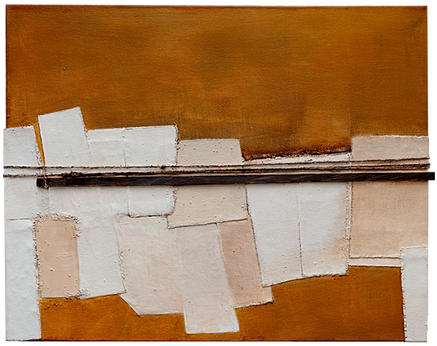
PULSE and NADA feature smaller, younger galleries who in turn discover new talent.  I encountered several artists for the first time whose work I look forward to following for years to come (*), but the "whoa! stop-me-in-my-tracks" moment was seeing from a distance the luminous color-field paintings by Tegene Kunbi in the Margaret Thatcher Projects booth at PULSE.  Call it the instantaneous seduction of artwork, the hunger to throw oneself into the art-- I cast fair decorum aside and nearly jogged into the Thatcher booth to see Kunbi's paintings. poster for Tegene Kunbi “Melting Pot”
All images here copyrighted to Tegene Kunbi and/or his legal representatives-- displayed here solely for non-commercial purposes of commentary, no copyright infringement intended.  

The images here do not convey the richness of Kunbi's color schemes, how the colors jump into the eye, how he sets one block in conversation with another and with the viewer.  Kunbi layers and articulates, and unabashedly shows us the artist's hand with his brushwork.  He evokes worlds--he is an alchemist like Klee, Rothko, Mitchell, Diebenkorn, Frankenthaler.  Kunbi had me thinking of Kandinsky on the spirituality of art.  Kunbi reminds us how powerful painting can be in the hands of a confident practitioner.  And, in an age wedded to irony and pusillanimous when it comes to any talk of artistic verities, Kunbi unironically presents us with Beauty-- surely still one of the main points of Art.

(*)  Check out Lisi Raskin,  Graham Collins, Retna, James Hoff, Rachel Foullon, Benjamin Horns, Charlie Billingham, Matthew Stone, Scott Treleaven, Emanuel Seitz, Ana Bidart, and Katherine Bernhardt.


Sunday, May 4, 2014

"The flight of the constellations returns hope to us."


Miro is one of my touchstones...or perhaps more like a spring bubbling exuberantly from the rock.

The painting above I have never seen before-- Sotheby's auctions it this week, so I am happy we get a look via the Web before it goes most likely to a private collector.

Another happiness is the title Miro gave it:   L'espoir nous revient par la fuite des constellations.

[Photo above copyrighted to ArtDaily.org-- shown here solely for non-commercial purposes of commentary; no infringement intended].

Sunday, April 20, 2014

On beyond Google

JELLY ROLL

Kevin Young's poetry inspires with a quirky minimalism and a sly swerving of the senses.

Best of all, he pulls language into a fresh order that is undeniable, something sharable with the reader while remaining very much his own.

He re-invents language.  Real poetry.  Authentic.

Take these lines from "Deep Song" from his collection, Jelly Roll:

"Belief is what
buries us—that

&  the belief in belief—
No longer

do I trust liltlessness
—leeward

is the world's
way [...]"

"Liltlessness."  Utterly perfect and completely unique.  Young coins this word, this concept-- the poet's gift to us.  

Sing on, Mr. Young!

For more by and about Young, click here. 

Sunday, March 30, 2014

Dragon & Clouds

The lobster and the canary are too busy at present to do more than point to beauty and wonder that inspires them, such as Dragon & Clouds, a painting on sliding doors (fusuma) by Soga Shohaku.  Made in 1763 CE, the work has just returned from Japan to the MFA in Boston.  If the lobster were still in Boston, he would go see this, dream himself out of the water and into the swirling clouds, with the canary perched on the dragon's crest.

Sunday, March 16, 2014

"Throwing The Ink": Pat Steir's Gestural Genius


[All artwork and images copyrighted to Pat Steir and/or her representatives; no infringement intended; images used here solely for non-commercial purposes, i.e., for commentary]


Pat Steir is an artist whose work deeply informs my own thinking about gesture, disciplined spontaneity, form and field.   (Click here for her bio).


In an excellent interview with Phong Bui  in The Brooklyn Rail (click here), Steir says that she was told thrown-ink painting began in the third century:  "I looked everywhere for it, I didn't understand what it was because I couldn't find it.  That was because thrown ink meant broken line, not traditional painting.  The artists did not actually throw the ink.  I was influenced by the idea of throwing the ink but it was just a misunderstanding.  I think a lot of art comes about through misunderstanding."


I just love that, the idea of misunderstanding yielding meaning and beauty.  I think the misguided search applies to life much more broadly.


Sunday, March 9, 2014

come celebrate with me: The Work of Lucille Clifton


The lobster & canary last wrote about Lucille Clifton upon the sad occasion of her death:  click here.

Yesterday, at Poets House in NYC, we spent time at the special exhibition come celebrate with me: The Work of Lucille Clifton.   Curated by Kevin Young, with Amy Hildreth Chen and Lisa Chinn, the collection of Clifton's books, notes, manuscript drafts and other ephemera stems from Emory University's libraries & archives.  

Click here for more.

Her voice is in our head forever.


Sunday, March 2, 2014

Fund science (thank you Neil deGrasse Tyson)


The wisest statement I read this week is a singularly compelling and important point that astrophysicist & public intellectual Neil deGrasse Tyson makes in an interview in the current issue of Wired magazine:

"...at least in America, science has been treated sort of cavalierly, not only by the public but also by government.  The idea that science is just some luxury that you'll get around to if you can afford it is regressive to any future a country might dream for itself.  Innovations in science and technology are the engines of the 21st-century economy; if you care about the wealth and health of your nation tomorrow, then you'd better rethink how you allocate taxes to fund science.  The federal budget needs to recognize this."

For more in this vein by deGrasse Tyson, click here.


Sunday, February 23, 2014

Dancing Architecture


Frank Stella, from his Scarlatti Kirkpatrick series (2006--ongoing)
All images copyright to the artist and/or his representative(s); images used here solely for purposes of commentary, i.e., non-commercial usage.

I always chuckle at the statement-- variously attributed to Martin Mull, Frank Zappa and several other musicians-- that "writing about music is like dancing about architecture" (click here).   I admire its glibness, but I do not agree; too precious, too clever by half, in my opinion.  Why shouldn't we cross those hoary boundaries?

Was recently reminded of this, seeing one of Stella's Scarlatti Kirkpatrick pieces at the Museum of Art & Design in NYC.   Stella bases his series on both the 17th-century Italian composer Scarlatti and on Yale musicologist & harpsichordist  Ralph Kirkpatrick, who authored the definitive catalog of Scarlatti's work in 1953.

As Stella says:  "If you follow an edge of a given work visually, and follow it through quickly, you find the sense of rhythm and movement that you get in music."

Click here for more on the Stella series.  

And here for a little Scarlatti.

Sunday, February 16, 2014

Hacking The Book


Su Blackwell, Out Of Narnia (2009)
(Blackwell holds the copyright; image used here solely for purposes of commentary, i.e., non-commercial).


The more digital our world becomes, the more we remember to cherish its physicality.  Not in a fetishistic way, or with antiquarian longing, but in a visceral, "cut to the gut" joy...we sculpt with our slow food, we mash up our music, we slice and dice our tweets and chats....

....and our books, oh my yes, we may read on a countless array of screens, yet still return to the printed page and its binding... as works of art in their own right.

Thinking of an upsurge over the past decade of mixed-media, hand-crafted works involving books, sometimes building on the tradition of "the artist's book," in other cases stemming more from scrapbooking practices, and in others from the principles of collage and iconoclasm saturating the Internet.   Su Blackwell transports us into the world within the book.  (Click here for more).  Last July we blogged about Lisa Occhipinti and her re-envisioning of the book as object.  (Click here).  Gabe Cyr's Mixed-Media Books: Dozens of Experiments In Altering Books is a lovely collection.   (Click here). 

Other resources:  Printed Matter, Inc. (click here).   The Contemporary Artists' Books Conference (click here).   1,000 Artists' Books: Exploring The Book As Art by Peter & Donna Thomas and Sandra Salamony (click here).    The Center for Book Arts (click here).   

Sunday, February 9, 2014

Mapping a billion stars: another space break


Giving ourselves another breather, after the long-form interview with Sandra Kasturi.

The European Space Agency is preparing to launch Gaia, a probe that will map a billion stars over five years.

Per the ESA site:

"It is expected to discover hundreds of thousands of new celestial objects, such as extra-solar planets and brown dwarfs, and observe hundreds of thousands of asteroids within our own Solar System. The mission will also study about 500 000 distant quasars and will provide stringent new tests of Albert Einstein’s General Theory of Relativity."

Click here for more.

Sunday, February 2, 2014

Sandra Kasturi Interview, Part Two


Question 4.  “Palelemon sunstreaks”...echoes of the “thick Teutonic languages, the languages of augurs” (as you put it in “Augury”).   Similar echoes throughout your poetry, for instance, in your “October Country”:  “the flotsam joy of the petal storm,” “purple-buttered thistle,” “deranged-yellow heat,” “that pan-cracked, brittle, ice-slippered sweet,” “its red-leaf-feathered, burnished golden limbs.”   Yet, hold on, strewn among the Germanic thicket are latinate flowers (“joy,” “deranged,” “burnish”) and blooms from the Greek (“petal,” “purple”) and Persian (“lemon”).   Talk about word choice and especially whether you think that being a poet from an officially multilingual country has made you more alert to the inner life of the words you choose.

 
Kasturi:  Well, with "palelemon sunstreaks" and other things of that ilk, I am probably cribbing a bit from the feel of Earl Birney's wonderful poem, "Anglo-Saxon Street" in which he evokes those old odes in a very modern setting. I always thought that poem was really funny, so it probably infused some of my work.

Language has probably always been important to me, though not in a conscious way. I was almost a polyglot growing up: English was my fourth language, after Estonian, Singhalese and German. I'm still fluent in Estonian, but Singhalese is completely gone, and German is like listening to a radio station that's not quite tuned in. I also have a smattering of French from the Canadian school system...but I think those early languages probably altered the way I think at a very young age. Some languages have concepts that simply can't be translated...so that probably gives you interesting pathways in the brain. I sometimes make funny typos when writing really fast--I'll start to spell something the Estonian way, and then when I look back, I go, "Whaaaat???" My favourite one was when I wanted to write "used to" and started typing "juust"--which is how it would be spelled in Estonian. Actually (felicitously!), "juust" means "cheese" in Estonian, so I had this weird bilingual typo/joke going on that probably only other Estonians (or maybe Finns) will find funny.

So yeah, maybe living in a multilingual country has helped? Cultural mosaic? Speaking a bunch of languages at an early ages? Nature/nurture? Who knows. But I love the sounds of words and I love stringing together things and making entirely new words. I was influenced in that by my friend, Carleton Wilson, who's a wonderful poet. He said in one poem something about "the branches of trees gnarcing..." I adored that. "Gnarcing" isn't a word, but of course you know immediately what he means. So perfect!


Question 5.  Words and images, and how to separate the dancer from the dance.  Which comes first for you: the words, summoned from the hoard in the middle of the night, needing then the image to clothe them in the light?  Or the image, born in those palelemon sunstreaks, needing the proper words to adorn them?  “Hummingbirds don’t fly south for the winter.  They just freeze/ where they are in the air, mistaken for speckles of winter/ sunlight, or, sometimes, low-hanging stars” (from “Hummingbird Hagiography”).   “You are black as bees,/ dark as the spine of a prison tower” (“Black as Bees”).  “Here is freedom, strange as irregular/ knitting.  The other side of the wall is static/ with bald poets, wry madmen and bizarre/ women flapping their arms in the attic” (“The Soft Key”).  “...a smile fifteen years in the making” (“Cryogenics”). 
Kasturi:  "Hummingbird Hagiography" is another cheat, I'm afraid, in that it was done for this wonderful poetry exercise called "Twenty Little Poetry Projects" by Jim Simmerman. I highly recommend it, especially for when you are creatively blocked. (http://mypage.siu.edu/puglove/twenty.htm) I wasn't blocked when I wrote that; we just did it in a poetry workshop I was running with David Clink. We also gave a 15-minute time restriction on writing it--a lot of great stuff came out of that exercise from a lot of people.

Generally, though, I think words come to me. I think in titles or in first lines, and they float around, and then the rest comes. I don't really think in images, but if the words help create the image, I guess I've done my job? Though I've done some ekphrastic poetry based on paintings or other images--but they're never as good, I feel. I guess my brain just doesn't work that way. I'm bookish to the core.


Question 6.  You’re funny--­I laughed out loud several times while reading Come Late, and chuckled often.   Daedalus spinning the story of Icarus in “Obese Mythologies,” the Avian High Supreme Action Committee requiring a special license for caged-bird keepers (shades of Monty Python!) in “Bird Logic,”  the European Bee-Eater going hungry because the bees have moved to condos in the city (“Regretful Orbits”), in your shoe the bee (“a sort of dirigibly-fat, apian/ ghost ship, damned for whatever sins bees/ commit.../ a bumbleship”) in “Big Bee Cosmology.”   Do you set out to be humorous or does the humor suggest itself as the poem emerges?
Kasturi:  I think I'm just weird. I don't usually set out to be funny. In fact, I've had poems receive huge yuks (like "After Misreading Emerson" which is my earlier collection, The Animal Bridegroom), which I've actually thought were sad poems. But then people laugh when I read them aloud. Go figure! Or maybe I just had my skirt tucked into my underpants or something.

But I do confess that sometimes there are things that I'm so enchanted with, and so charmed by, that I really hope other people will feel the same way. Bumbleship! Who wouldn't like that? It's adorable.

Like many other people, I think I find the universe and existing in it to be this kind of absurdist comedy, so maybe that comes through?

It's nice to hear I'm funny, though. Feel free to tell me that, often.


Question 7.  Humorous yes but often tinged with sorrow, with longing for the unattainable, with la musica del amargue:  “Just as you and I wish to be birds...wish to listen to the fabled echo, the faint/ but steady pull of birdsong, that brags/ to landbound mammals about the joys of flight,/ the sweeping pull of wings” (“The Movement of Men and Gods”);  “Let us end this tyranny/ of waiting, of longing to fly/ south for the winter, to imaginary/ countries where it only rains/ lullabies...” (“Let Us Begin”); “We are not wading,/ but are treading water carefully/ in a narrow sea” (“Godwit”).  Does writing poetry ease your yearnings, or enflame them?
Kasturi:  I've felt lost for much of my life, I think. Or maybe I read too many fairy tales. That's also possible. It's not surprising that Sondheim's "Into the Woods" is one of my favourite musicals of all time. I love stories and reversals in stories and tales that go wrong.

I often feel like I'm homesick for places I've never been or that are long past, or places that don't even exist: Agatha Christie's England, Michael Gruber's voodoo-riddled Miami, Hogwarts, 1920s Paris. Narnia. Middle-Earth. Though I look at that list and realize that all those places were filled with terrible things. Murder, racism, dictators, evil and abuses of all sorts. I always thought the Germans would have some sort of giant compound word for "longing for places that you have never been" but I haven't found it yet. I just finished rereading The Lord of the Rings for the umpteenth time, but for the first time in my life, I wept at the end. What's that about? Sorrow at partings, at journey's (and book's) end? Yearning for magical things? Yearning for the time in my childhood when I first read it? Knowing I can never re-experience that first sense of wonder again? Nostalgia, that criminal muse? God, it's all so terribly sentimental and maudlin, isn't it? I'm ashamed of myself!

I think writing, for me, gets the yearning on the page. Does it ease anguish? No, I don't think so. But maybe it gives it parameters. Here is the very thing that is breaking your heart: you can look at it cleanly. Does doing this mend you? No. But knowing a thing can help.

I don't reread the sad poems like "Godwit" much. Elegies are often too hard and the memory is (cliché alert!) like probing a sore tooth. You become like Laurence Olivier doing terrible things to your mouth, muttering "Is it safe?" Why do that to yourself? Of course I do it. We all do it. That terrible, delicious anguish of loss and memory.


Question 8.  Along the same lines, I recently ran across this statement in Mary Ruefle’s “On Beginnings” (in her collected lectures, Madness, Rack and Honey):   “Gaston Bachelard says the single most succinct and astonishing thing: We begin in admiration and we end by organizing our disappointment.”   Your reaction to this sentiment?
 
Kasturi:  Ha! That's wonderful. It's such an enormous statement on so many levels, I'm not sure I can even answer properly. My initial reactions: Hilarious! Awful. Apt. Why can't I say anything that profound? Depressing. Is that my own humdrum little life? Do I admire myself and my work only to find it all terribly disappointing? Embarrassment and shame at the possibility of admiring myself too much. Not done! Off-track. What did Daniel ask me? Oh yeah, that quotation. Hilarious! No, sad. Do I understand it? Or myself? Or my writing? Maybe not.

Maybe that's the best example of how my squirrelly, self-absorbed little brain works. Show me something profound, and all I can think of is how it relates to me. Quel horreur!