Sunday, March 28, 2010

Sunday Morning Coffee: "Harlequin," Lunacon, and Middle-Earth More Real Than the New Yorker


[Dave Grusin, Lee Ritenour, Ivan Lins, "Harlequin," 1985]


[Margaret Organ-Kean, "Masque," no date, c. 2008]


[Matthew Stewart, "Dernhelm," 2009]


[K.M. Kotulak, "Hiberno-Curio," 2009]


[Christy Grandjean, a.k.a, Goldenwolf, "Spirit Hunter," 2007]


[Donato Giancola, "Out of the Frying Pan, Into the Fire," 2009]

Coffee is ready! We're listening to "Harlequin" this morning, recalling the show by vocalist Ivan Lins at the Blue Note in the Village a few years ago.

The lobster and the canary participated last weekend in Lunacon, the oldest science fiction/fantasy convention in New York. The usual variety of panels and talks. Most impressive was the art show, featuring works by (among many others) Margaret Organ-Kean, Matthew Stewart, K.M. Kotulak, Christy Grandjean, and Donato Giancola. Giancola also painted a picture of Smaug, the dragon in The Hobbit, in front of a rapt crowd, genially explaining his choices as the painting emerged before our eyes. The canary snapped photos of Giancola in action, which we will post this week.

Lobster stirs his coffee with one claw, and savors this quote from Ross Douthat in the March 25th New York Times:

"The whole reason that modern fantasy, in all its various guises, has proven such a potent genre is precisely because it seems to capture more of reality than its technically-more-realistic competitors. Fantasy re-enchants our disenchanted world, and recaptures something essential to mortal experience along the way: Whether you literally believe in fairies or not, a great fairy tale is truer to the richness of human affairs than many “New Yorker” short stories. I’ve felt this with many fantasy writers, but like many readers I felt it first and strongest with Tolkien — and whenever I return to him, I feel it still."

Click here for the entire essay.

Saturday, March 27, 2010

Recommended Reading: First Quarter, 2010

Lobster murmurs and canary whistles... time to blog again...

Recommended books read this first quarter of 2010:

We highly recommend N.K. Jemisin's debut, The Hundred Thousand Kingdoms (Orbit, released February, 2010). Jemisin has created a distinctive world, with idiosyncratic characters, vaguely Peakean in flavor, but entirely her own. We especially enjoy her dry wit, precise prose, and intricate plotting. Above all, we like her portrayals of the gods who have been enslaved: they are both more and less than human, raising a chill up the reader's spine while also tugging at our heart. We love them, fear them, do not understand them all at once-- we are as baffled, entranced and repelled as the heroine Yeine is by the immortal trickster youth Sieh and the terrifying (and terrifyingly erotic) Nightlord Nahadoth. Jemisin promises us two more in this series-- we await these eagerly.

Cherie Priest also does a fine job creating alien (eldritch, to use an overused but in this case very appropriate word) characters in Fathom (Tor, 2008, first paperback release February, 2010). The water elemental Arahab seeks to awake Leviathian from his slumbers deep below the earth's crust-- which will destroy the world. Yet Arahab is no caricature of evil: her actions have a defensible if wholly alien logic and ethic; she is willful, mercurial, but she weighs and measures, ponders, has doubts, is not merely hateful. If anyone is truly and one-sidedly evil in Fathom, it is the human Berenice, who betrays everyone, including her savior and patron Arahab. And then there is the enigmatic spirit called Mossfeaster: "From the feet up, the creature began to dissolve itself, not so much collapsing as letting the ground absorb it. But before the last of the shoulders, neck and head disappeared, it offered one final thought. 'You can help a thing who loves the world destroy it; or you can help a thing who hates it save it'" (page 100).

Spiritual quandaries also pervade Steal Across the Sky by Nancy Kress (Tor, 2009, first paperback edition February, 2010). Extraterrestials arrive to atone for a crime against humanity that no one on Earth knows anything about. "The Atoners" take selected humans to other planets to witness the consequences of this crime. Kress combines fast-paced drama with thought-provoking propositions. The revelations of the witnesses challenge deeply held beliefs; Kress is very good at describing how humanity reacts, in ways both trivial (celebrity tours, pop culture engulfment) and mortally important.

Incarceron by Catherine Fisher (Hodder U.K., 2007; first U.S. edition, Dial/Penguin, 2010) is really, really good. Finn has no memories of his past, but is now a Prisoner in the unimaginably vicious, squalid and vast prison-world of Incarceron-- a prison that is itself coldly intelligent, indifferently manipulating the fates of its inhabitants. There is and can be no escape from Incarceron. But where is Incarceron? That is the question for Claudia, daughter of the Warden, and her tutor, the Sapient Jared. As Finn and his deceitful, half-crazed companions desperately seek to escape the inescapable, Claudia (about to be married against her will to the Crown Prince) is furiously trying to locate Incarceron...all the more so when she and Finn stumble into conversation via a matched set of scientifico-magical Keys. Incarceron has it all: a twisting plot, flawed and believable characters, settings that live on after you shut the page. Peake and Vance come to mind, The Man in the Iron Mask, Dickens, Suzanne Collins's Hunger Games... we look forward to Incarceron's sequel, Sapphique.

Saturday, March 13, 2010

Sharon Dolin: Composing for the eye


The lobster and canary are especially delighted to offer today's post: an interview with widely acclaimed poet Sharon Dolin. Sharon has published four books and five chapbooks of poetry. She is Writer-in-Residence at Eugene Lang College, The New School and she also teaches at the Unterberg Poetry Center of the 92nd Street Y in NYC.

Click here for her website.

Lobster & Canary: You frequently give readings. How does reading your work aloud for an audience influence (or not) how you compose in the first place? Talk to us about the interaction of writing and performance as it may apply to your poetry.

Sharon: I don’t think that reading my work aloud before an audience influences the way I compose poetry. Certainly, I read my work aloud to myself while in the process of revision in order to catch the rhythms, to see if there is any unwelcome awkwardness (although sometimes awkwardness is the point). I come out of the Williams tradition and compose much more for the eye than for the ear. I spend a lot of time thinking about how a poem looks on the page. Is there enough white space? Should the poem have uniform stanzas? How long should the lines be? Are the enjambments perky?

Of course I enjoy giving readings, to feel firsthand how a poem goes over to a live audience. But this means that I carefully choose which poems work better at a reading and which poems work much better on the page. There are some poems that I would never read aloud to an audience.

L & C. You pay great attention to formal technique-- you are perhaps unusual in this (?). (Among your peers, I think of Molly Peacock, the late Reginald Shepherd, Susan Stewart, Louise Gluck, W.S. Merwin, but not so many others.) Tell us a little about that, about how you see form in relation to content. Do your words and images arise first, followed by the search for appropriate structure, or vice versa, or in some other order altogether?

Sharon: It’s funny that you should say I pay great attention to formal technique. I think of myself as a free verse poet, but one who has worked very hard, both in my poetry and in my theoretical writings about free verse, to claim that free verse is as formal as any poetry written in a fixed form. That the burden of finding the form is even more onerous for a free verse poet. Of course, I deplore how much sloppy free verse writing is out there, how many poems are merely prose chopped up into lines. I hope my poems never fail in that way. I think very carefully about the constitution of the line. Each line in a poem has to carry its own weight. Charles Wright has written some of the best essays on the subject. So I make no distinction between poems that use a fixed form, such as the ghazal (one of my favorites) and poems that have no identifiable formal label.

That said, usually an image or idea hits me first. Sometimes the form follows almost immediately and sometimes I struggle with making the two marry each other. Here are a few examples: In my first book Heart Work, there’s a long poem called “Praying Mantis in Brooklyn.” I knew right from the start that the poem would take the form of a sestina followed by a free verse expatiation on it. What had happened was a praying mantis appeared several times in very unlikely places: on the windowsill of my 4th floor walkup and on my street gate. The uncanniness of the meeting and the strangeness of the insect got me to thinking about Louis Zukofsky’s famous poem (really my favorite of his short works) called simply “Mantis,” in which a praying mantis flies at his chest on the NYC subway. He wrote this poem during the Depression and the mantis came to stand for the poor. He used a sestina followed by a free verse riff. In the late Eighties, when I wrote my poem, when there were lots of homeless on the streets of New York, I decided I would write my own Mantis poem with a nod to Zukofsky by using the same two-part form.

The same think happened with a poem in Burn and Dodge, my fourth book. I was at the Philadelphia Zoo, watching my niece and her girlfriend watching two tortoises copulate. I wanted to write a poem about the tortoises and about my niece coming out to the family. It seemed necessary to me that the poem take the form of a syllabic, Marianne Moore’s characteristic form, because she loved to go to the zoo and because she was so prissy about any sexual content entering her work. So my poem was an irreverent syllabic.

And here’s one more example of how I think about form over the course of a sequence of poems: In Serious Pink, my ekphrastic collection, I thought about the fact that Howard Hodgkin always paints over his frames. So in my sequence of poems in dialogue with his work, I wanted a flexible framing device. I decided to write 15-line lyrics in varying stanzaic patterns—near sonnets. Of course, in one poem, a ghazal it had to be 16 lines, an even number of lines, to accommodate the couplet form.

Many of the “free verse” poems in Burn and Dodge that deal with contemporary vices are written in tercets because I think of that form as a nod to Dante’s terza rima form in the Inferno.
In one of those poems, “Cursed Anger Sing” (Anger being one of the original Seven Deadly Sins), I chose a backwards moving tercet, because I think of anger as something we are only aware of in retrospect. Here’s the opening stanza:

Wound inside snake coils, cruel lover of blood
who sees only red, unlike Gluttony, Lust
and Sloth, when you are wroth . . .

Here you see I do also enjoy playing with internal rhyme as well.

In the poem “Grudge,” I chose boxy quatrains because there is something closed off about that emotion. Here’s the first stanza:

Holding–bearing—carrying.
To have is not to surrender
pockets of the mind
where hurt sojourns.

Finally, I probably feel drawn to couplets when there is a strong sense of a dialogic you and I, or some kind of love, as in the poem written for my son called “Shame.”

When my five-year-old, not listening , climbed over
the broken fence head first

and fell (the gash on his cheek, a huge backward “C”),
we didn’t recognize, as he bled,

what he’d opened up for himself . . .

Again, what I am calling a retrospective lineation, a not-seeing until after the fact, as well a way to represent non-alignment of self with the world at the same time preserving the couplet as a sign of tenderness between my son and myself. I was not trying for radical enjambments in this poem, which tells a story.

Elsewhere, more radical line breaks might be the rule.

L & C: We love your ekphrastic work. Which visual artists are you following with particular avidity right now, and why?

Sharon: First, thank you. Serious Pink remains the book I’m proudest of, in a way. I can’t say I “follow” particular artists. It’s all about serendipity. And I never know in advance what kind of book I’ll be writing. I just write poems and see where it takes me. Serious Pink began with the Joan Mitchell sequence, “My Black Paintings,” because I happened to visit the Robert Miller gallery to see a show of Mitchell’s work from the mid-Sixties that she called her “Black Paintings.” They were painted (I initially wrote “written” here!) when she was recovering from the death of her father and when her mother was ill with cancer. I, too, was slowly recovering from the untimely accidental death of my fiancĂ© who, by the way, liked Joan Mitchell’s work. Perhaps that’s why I attended the show. Anyway, it gave me a way to write about the loss indirectly (I had already written a sequence of poems about him, published finally in Realm of the Possible in a section entitled “Geniza.”). So I bought the catalogue and decided to write about one of the paintings. Then the next. And the next. There are other stories for each of the other sequences, always quite personal. I was also interested at the time (this was in the mid-90s) in how I could write about abstract painting. Most ekphrasis, as you know, is the art of description. How do you describe an abstract painting? You don’t. So I had to do something else. That was my adventure. And in each of the sequences I approached it differently. Here’s one of the poems from the sequence “Black Paintings” that makes the elegiac subject matter quite clear:


BLACK PAINTING #2: THE DEAD


Blue winter rain
that's what you’ve become

a cloud
whitewashed by weather

this window
beyond being

the elements eat you

damp cold
of the first winter

now the second
you said you wanted

to travel
now you're still

blotches of flight
descend into your

stationary car


In my last book, Burn and Dodge, where there is a quadriptych scattered throughout the book on Envy, the final one is, as the title says, my “Letter to Seven-Hundred-Year-Old Invidia in the Scrovegni Chapel to be Folded in the Shape of a Snake Swallowing Its Tail.” I imagine Giotto’s figure of Envy looking across at the figure of Prudentia, who looks like a writer to me, and being envious of her. I thought of the poem in sculptural terms: Envy as a circle from which one never exits. Here’s the first stanza, which is almost purely descriptive of Giotto’s Invidia—well, obviously as seen through my manic eyes:


Letter to 700-Year-Old Invidia in the Scrovegni Chapel to be Folded in the Shape
of a Snake Swallowing its Tail

. . . out of your niche, Galatea'd on hate,
if it weren't for the bloody anemonaed
flames (coelacanthed), that hold you phoenixed
rebirthed, recursed
consuming you spewing you flue-ing
you up. Clutching your moneybag already
cinched
by the tasseled rope at your waist
and reaching to grasp—what?—You can barely see
for the serpent jutting from your mouth whose head circles
back to flick its tongue
over your eyes—your ears so outsized—batlike cartilage
ram's horns wrap around.


Right now, I am not “following” any artist in particular. A few years ago, I was looking at a painting by Cy Twombly called “Scenes from an Ideal Marriage” and that sparked me to write about my own very imperfect marriage. It’s a poem in four parts that got published by Ducts (http://www.ducts.org/content/scenes-from-an-ideal-marriage/).

L & C: The canary in particular is struck that so little poetry is written about music (as opposed to the visual arts, and not meaning lyrics composed for and as part of song). A case of sibling rivalry? Your thoughts?

Sharon: I think the tradition of ekphrasis, which began with Achilles shield in The Iliad, has always been one of the visual arts. Lessing’s book on the Laocoon was an entire argument about the strengths of sculpture and painting compared to poetry. Debussy’s Prelude to an Afternoon of the Fawn, was inspired by a MallarmĂ© poem. I think there are lots of contemporary composers who set poems to music. I’m not sure what to call that. It’s reverse ekphrasis: from words to images. We’ve had a few notable examples of that in painting: Charles Demuth’s painting I Saw the Figure 5 in Gold after Williams’s “The Great Figure.” There just seems to be a primacy to the image as visual as opposed to auditory. Poems are put to music as opposed to poems written about music. Think of the American art song tradition: Aaron Copland’s "Twelve Poems of Emily Dickinson,” for instance. And contemporary composers such as Ned Rorem or Tom Cipullo come to mind but there are many others.

L & C: Robert Pinsky, in "Culture" (the first chapter of his Democracy, Culture and The Voice of Poetry) glosses Tocqueville's assertion that American democracy "has dried up most of the old springs of poetry." Pinsky suggests Tocqueville should be read to mean poetry's trajectory in the U.S.A. is the result of "not exactly the absence of legends, memorials, heroes, and pantheons but their insufficiency: a worn, jejune quality--a need for something either more candid, or more candidly fantastic." If the Tocquevillian premise is sound, then how has American poetry become either more candid, or more frankly fantastic over the past 150 years?

Sharon: I understand Tocqueville to mean that we don’t write public poetry anymore: to dead heroes or to living presidents after Whitman. Or, at the least, that’s not the source of our best poetry. I find this question a puzzling one as someone who has always been more interested in the lyric than the epic. I go to poetry—both to read and write it—for what the solitary voice has to say from his or her personal experience. The is one of the oldest “springs” of poetry. I never find myself moved by public poetry. It’s why I love the Psalms, no matter who has written them, because they are the voice of an individual, not a people. I’m not the first one to say that the tragedy of 9/11 reminded people that poetry could offer a certain kind of solace through an expression of grief that can’t be duplicated by other art forms.

American poetry as more candid or more fantastic? These elements have always been present in American poetry. Who is more candid than Whitman? Who is more fantastic than Poe or Dickinson? I think the use of language has changed, perhaps due to a sense of audience: poets more and more writing for each other. Or perhaps the causal connection is reversed: the language has changed and that has led to a falling away of audience. But that is another matter entirely.

L & C: If you were exploring poetry with sixth-graders in NYC, which poems might you include on the syllabus?

Sharon: As the mother of a fifth-grader who rolls his eyes at the mention of poetry, I think I’m going to duck this question and say: That’s why I prefer to teach college students and adults.

L & C: Fair enough! Thank you very much, Sharon, for your poetry and for your thoughts about the craft.

Thursday, March 11, 2010

Supper's Ready


[Chaim Soutine, Still Life with Fish, c. 1921]


[Paul Cezanne, Ginger Jar and Fruit, 1895]


[Pierre Bonnard, The Dining Room, c. 1940-1946]

Tuesday, March 9, 2010

Wood and Barthes and the Unreality of Realistic Fiction

James Wood in the current New Yorker (ppg. 71-72):

"The French literary theorist Roland Barthes['s]...larger argument...was that realistic fiction, like ideology, tries to palm itself off as the most natural and real of literary modes but is in fact the most artificial and unreal. Barthes is ninety-nine percent right.

[...]

But Barthes is one per cent wrong, too; and, like the one per cent that separates us genetically from chimpanzees, Barthes's tiny wrongness is quite large."

Sunday, March 7, 2010

The Armory Show 2010


[Joao Pedro Vale, "Of the Monstrous & Less Erroneous Pictures of Whales (I)," (2009)]


[Kristine Roepstorff, "Exercise Within the Frame (Including the Summer of Discontent)" (from the series, It's Not the Eye of the Needle That Changed, 2007)].


[William Daniels, "Vase of Flowers with Pocket Watch (1)," (2005)]


[Leonardo Drew, "Number 33.a" (rust, shoes, 1999).


[Eva Lundsager, "Hermit Style" (2006)]


[Pablo Bronstein, "Two Architectural Studies in the Style of Jean Jacques Lequeu" (2005).]


[Polly Morgan, "Still Birth (Blue)," (2009).]


[Martin Jacobson, drawing (2009).]


[Andrew Sendor, "Alejandro Celestino, Artist Unknown, 2013, human beings & mixed media, dimensions variable, Soliloquoy, Ana Libitina, 2012, video projection, 107 minutes (detail)" (2009).]


[Kristof Kintera, "I see, I see, I see," (2009) a talking, animatronic raven-man sitting on a branch above the viewer's head.]


[Jorma Puranen,"Shadows, Reflections and All That Sort of Thing, #42" (2008).]

Yesterday we delved and dallied at The Armory Show, one of the largest contemporary art shows in the world (click here for more.) In a delightfully confusing way, The Armory Show is held not at The Armory but at Piers 92 and 94 on the Hudson, while The Armory holds a similar show sponsored by the Art Dealers Association of America. Elsewhere in Manhattan, some dozen other venues are hosting contemporary art shows this week as well. A feast beyond reckoning...

Reproduced above are some of the artists who caught our eye, with notes below (in some cases the image above is of a piece we saw at the show yesterday, in others-- unable to find an image from the show-- we have posted an image that most closely resembles what we saw).

Generally speaking:

* The Europeans seemed more inventive and adventurous than the Americans.

* The children reject their parents (abstraction was little in evidence), reach back to their grandparents (much here in the spirit of Dada and Surrealism).

* The naked female body was everywhere on display-- the male nude, um, not so much. Why is that?

* Prominent: mixed media, collage and assemblage, woven and stitched objects, textural detail, lots of attention to surface and color (shiny, shiny, bright, bright), less to form and composition.

* Perhaps the most striking image was Marina Abramovic's "The Kitchen II: Homage to Saint Therese" (2009). Click here to see (scroll to the fifth image in the series).

* Also arresting was a very large (digitally manipulated?) photograph by Vanessa Beecroft of marble-white female nudes in a somber-grey medieval cathedral. We cannot locate that image but click here for a sense of Beecroft's work.

*Jennifer Steinkamp's "Orbit 2" is a mesmerizing digital piece, with a mass of leaves and branches in constant motion, swirling, emerging. It is Tolkien's Lothlorien come to life. Click here to play the video.

Click here for more on Roepstorff, and here for more on Vale.

Daniels appeals strongly to the neo-antiquarian in us: he re-envisions works by the Old Masters, first re-creating an iconic painting as a torn paper maquette, then painting an image of the maquette, in painstaking detail. Fractalish homage... Click here for more.

Drew's vision is subtle, powerful, elusive. The canary tries to alight, but cannot; the lobster seeks to seize, but cannot. Click here for more.

Lundsager (one of the few abstractionists) had several powerful paintings-- what is our word for "that which draws you in, into which you fall and fold yourself"? Writing about the Lundsager above (which was not at the show, but is a good proxy), Stephanie Buhmann wrote in The Brooklyn Rail (July-August, 2006): "...this soil is far from infertile, and various mysterious structures made of dotted lines and curvilinear swirls have begun to populate the scenery. As they thrive, so might our trust in the eternal cycle of life, which proves that even a lava field will at some point serve as a breeding ground for new life forms."

Bronstein creates mythical pasts for real buildings: "His palette encompasses a myriad of styles: from the mannered baroque of Turin to the classical architecture of 18th-century France, from early 20th-century Modernism to Postmodernism... Adopting the guise of the architect, architectural historian, and the user of buildings, Bronstein reveals what might be described as the veneer of architecture." [quote from The Metropolitan Museum website-- for more, click here, then scroll down to mid-page.]

See more of Morgan's work here.

Jacobson about his work: "My work is based on the curiosity and fascination of that which is beyond my understanding and experience. I try to see and read the phenomena and objects that come in my way. I search for provisional recipes or methods, which can articulate and activate something in me or in somebody else. I search for the combinations for the locked parts of my consciousness. Some objects and phenomena remind me of the inadequacy of my senses and my state of awoken sleep..." For more, click here.

Click here for more by Sendor.

Click here and here for more on Kintera.

Puranen on his approach: " ' While photographing painted portraits I thought that what I was doing was in fact like knocking on the frame of a painting and asking "Is anyone there?" or saying "Wake up, I know you're there.' " For more, see Galerie Anhava's site here

Saturday, March 6, 2010

Thinking of Alice


One of Rackham's illustrations... looking forward to seeing the Burton version on screen soon...

Tuesday, March 2, 2010

The river's story


Johan Sevenbom, c. 1765, drawing of a river god.

Begs for a story or a poem about this riparian old-father.

Bring out your quill, sings the canary!

Monday, March 1, 2010

Left brain, right brain: Data are gorgeous


AH, the lobster and the canary find nourishment for their oh-so-different brains....

David McCandless offers up data visualizations that qualify as art... in his new book Information is Beautiful, and his blog of the same name...click here.

Sunday, February 28, 2010

Sunday Morning: Coffee, Blogs, and Remembering Lucille Clifton

The Sunday review, with milk-lashed coffee.

In the air and in my ear: Maria Schneider Orchestra, then Hiromi Uehara... followed by Macy Gray, and now the North Mississippi Allstars...

David Brin worries that the search for extraterrestial life might be the equivalent of yelling "yoo hoo" in a dark forest, thereby drawing in the predators... click here for more.

Mark Anthony Neal interviews Sofia Quintero (aka Black Artemis, co-founder of Chica Luna Productions)-- click here.

Jai Arjun Singh provides good insight into Syed Muhammad Ashraf's The Beast, a 1997 novella recently translated into English by Musharraf Ali Farooqi. Click here, and go to Singh's Feb. 17 posting.

Finally, the lobster and the canary bow their heads (but lift up their hearts!) in memory of the poet Lucille Clifton, who died February 13th in Baltimore, aged 73. We will miss her voice, so direct, so compassionate, able to draw down and expose meaning in the most humble and daily of details.

Elizabeth Alexander's salute to Clifton (in The New Yorker online, Feb. 17th) is particularly fine: click here.

Saturday, February 27, 2010

N.K. Jemisin's The Hundred Thousand Kingdoms

Nora K. Jemisin : Orbit published her first novel, The Hundred Thousand Kingdoms, this past week.

The launch party Thursday evening in Soho, NYC was wonderful. Despite slush, snow and sleet, the room was packed. Spotted: Ellen Kushner, Alaya Dawn Johnson, Matt Kressel, Tempest Bradford, Delia Sherman, Ellen Datlow.

Congratulations Nora! The lobster and the canary hope to interview Nora soon.

Wednesday, February 24, 2010

Monday, February 22, 2010

Don't read this blog! Read a novel instead!

From "The Future of Reading" by Josh Quittner in Fortune (March 1, 2010, pg. 66):

"People definitely want to browse. ... But many also crave deep reading experiences. Man does not live by blog alone! It would be like surviving entirely on cupcakes."

Well said! The lobster urges you, gentle reader, to delve into a novel this evening, once you quit our blog for today.

Sunday, February 21, 2010

Sunday Morning: Coffee, The World's Largest Book, and Blogs


[Photo from The Guardian.co.uk, article by Mark Brown, January 26, 2010]

Sunday morning, snow on the ground but a hint of spring in the blue air.

Coffee with brown sugar and a dash of grated nutmeg.

Jean-Luc Ponty and Tangerine Dream on the airwaves.

The world's largest book goes on display at the British Museum in April: the Klencke Atlas, given by Dutch merchant Johannes Klencke to Charles II at the Restoration in 1660.

I want to walk into this book, lose myself in the lands it depicts.

I wonder if we'd find Uqbar somewhere in its massive pages?

While imagining that, check out the February issue of Bookslut. Elizabeth Bachner has an excellent piece on Dubravka Ugresic's Baba Yaga Laid an Egg (Ugresic is also featured in the current issue of Bookforum-- this novel goes on the lobster's tbr list).

Also in Bookslut this month-- a good interview of Maryse Conde by Megan Doll.

Conde on the truth of story: "You know, people will tell you that in places like the Caribbean, West Africa and so on, we have two distinct elements. We have history which is written in books about the white people -- how they came to Guadeloupe, how they colonized Guadeloupe, how they became the masters of Guadeloupe -- and you have memory, which is the actual facts of the people of Guadeloupe and Martinique -- the way they lived, the way they suffered, the way they enjoyed life. We are trained to rely more on our memories and the memories of people around us than on books."

The Quarterly Conversation has many good things (as always). My favorite this go-round is Tony Miksanek's review of Selected Prose of Heinrich von Kleist (trans., with afterword, by Peter Wortsman; Archipelago Books). Miksanek: "In the hands of von Kleist, paradox and dramatic irony are not literary devices but rather fundamental features of ordinary life."

At Cabinet des Fees, Erzebet YellowBoy reviews Ali Shaw's The Girl with Glass Feet.

*Canary hops from one foot to the other-- another book for the tbr list-- let us petition the sun for just twenty extra minutes a day*

Saturday, February 20, 2010

Nebula Award Nominees Announced

The Science Fiction & Fantasy Writers of America has released the nominees for the Nebula Awards.

Click here for the list of nominees.

The nominees for best novel are particularly strong.

Thursday, February 18, 2010

Tanguy and the Indefinitely Divided


(Yves Tanguy, Indefinite Divisibility, painted in 1942).
Last night, Canary dreamed a dream of a Tanguy landscape.
Barbs that climbed the sky, a hazed sky.
Beware the mirror's reverse, the world behind the mirror.

Monday, February 15, 2010

Eleanor Wilner on the Past

A thought from poet Eleanor Wilner that I have been mulling for several years:

"As we change the past, so we are changed."

(From her late 1990s essay, "Playing the Changes," for which I need of course a more precise citation-- I am not sure from whence it fetched up in my commonplace book.)

A truism...but much more than that, as Wilner explores the nature of history, change, historicity.

Which drives at the heart of narrative, storytelling, the coming-at of the truth of things.

Reminds me of the work of Reinhart Koselleck, Hayden White, Roger Chartier and other historians who have sought the origins of historical phenomena in terms of rhetorical strategy.

Borges's "Circular Ruins." The Sun Stone by Paz.

Battlestar Galactica.

Sunday, February 14, 2010

Sunday Morning: Coffee, "My Funny Valentine," and Blogs


Coffee, with lots of hot milk, frothy.

Cold outside, very cold. Gulls skimming the Hudson, Brant Geese seeking shelter by the ferry landing.

"My Funny Valentine" -- the Miles Davis version.

And time to catch up on what others are saying. To savor and digest.

Three whose separate musings constantly inspire: Kate Castelli's Wandering But Not Lost,Sonya Taaffe's Myth Happens, and Leigh Batnick's Jezebel, Correspondence for the Vagabond Heart. Reading their daily entries is like reading Stefan Zweig or Borges, receiving a letter from Virginia Woolf or Marianne Moore, scanning the sketchbooks of Klee or Matisse.

Above is "A Field Guide to Airships," Castelli's February 4th entry--inspired by Italo Calvino's Invisible Cities.

Picking a recent post at random from Myth Happens, the January 23rd on Macbeth ("your eyes were glacial and your promises all rang true"): "The world of Macbeth is one of witches and worse things waiting, curses and prophesies and adynata that come, however slantwise—none of woman born, till Birnam wood remove to Dunsinane—true. (I'm with Tolkien, however, in being disappointed that the actual wood does not go anywhere. I really expected it to, the first time I read Macbeth. It's like an entire forest of Chekhov's gun.) It's not the most supernatural play in the canon, but it's got to be up there. Ghosts and apparitions are not suspensions of disbelief, but factual as branches or blades. And words are spells. Our chief guest, all-thing unbecoming, a most indissoluble tie, this is performative speech. So don't command someone to dinner and then kill him, for the love of little green apples. Especially in a Scotland of völur, you're a fool if you think a man's death is a stronger bond than his word."

Or, at Jezebel ("bookworms, gin drinkers, slip off your satin slippers...I've been waiting for you"), the February 12th entry on the death of Alexander McQueen: "A ghost in your world, before you became a ghost in ours. The angels will be more beautiful than ever - a dressmaker for the cosmos is in their midst."

Elegies also for two other recently departed: Cat Rambo's "Goodbye to Kage Baker," February 4th in Fantasy Magazine, and Ambling Along the Aqueduct's Feb. 9th "RIP Phil Klass" (a.k.a. William Tenn).

Gary K. Wolfe in the current Locus (paper version, pg. 16, not sure if this has been posted online yet) captures my feeling perfectly: "Like many, I was never particularly anxious to see [Peter S.] Beagle return to the world of The Last Unicorn, which is one of those books that seems such a pristine emblem of youthful reading and discovering the possibilities of fantasy, that it just shouldn't be messed with..."

Check out: "Nice Makes Write: An Interview with Casey Wolf," by Robert Runte, Feb. 8th in Strange Horizons; Sharon Butler's coverage of the discussions at the College Art Association's annual conference, Feb. 13th at her Two Coats of Paint; Laila Lalami's Feb. 12th note on Monique Truong's debut novel; and Jonathan Jones in The Guardian, Feb. 11th on Gorky and Rothko: "they aspired to greatness – a quality almost no art nowadays believes it can attain. Some people call them pompous for that; I call them courageous."

To round out the morning, a haunting poem by Mitchell Douglas, "Poem of the Week" right now at Cave Canem, entitled "Midnight Hour." It opens:

"He plays when dreams come, when
the hour is as late as the moon
allows, when
ribbons of light
slice window panes, shine
for the sake of sight."

Go re-fill your coffee mug, put some more Miles in your headspace, and read the rest of the poem.

Friday, February 12, 2010

KeKe Cribbs on play

Ceramicist KeKe Cribbs on play:

"Play is so important because it involves a willingness to fall down, make mistakes and learn from them."

(From Lynda McDaniel, "The Art of Play," in AmericanStyle, Winter 2009-2010.)

Click here for more.

Wednesday, February 10, 2010

Adela Leibowitz: Luminous Dreamscapes


Adela Leibowitz is a painter you will hear much more about in the next few years. Her work is a portal into other worlds. The three examples above are all oil on linen, painted in 2008: Les fleurs du mal (Flowers of evil); Masque of the Red Death; History of Sin.

Click here for more about Adela.

Adela kindly answered a few questions for us.

Lobster & Canary 1. Reviewers frequently refer to the "dreamlike" quality of your work-- which I will echo. Do you find that a fitting descriptor, and, if so, why? Are your images taken from your dreams?

Adela: Dreamlike is a good description. The images aren’t taken from my dreams, but the moods or impressions that the dreams leave behind do make their way in.

2. Reviewers also note the "luminous" quality of your technique. Your use of color emerging (if the lobster can coin a phrase) reminds us a little of Turner, or of the French Impressionists. Do you paint studies for your finished pieces, playing with and adjusting the quality of the light? How do you know when you have hit just the right mood?

Adela: I guess some things just feel right, other times you just know when it’s not. Sometimes it’s a search and takes quite a few layers of addition and subtraction to kind of push in the direction where you want it to go. I’ve done studies and other times I don’t do any studies and just jump right in. I usually regret when I don’t do studies first because a lot more paint goes into pushing it in different directions. Then again, sometimes really unexpected positive things happen in that process, so it can work out both ways.

3. Your early Nowhere series (2001) is stark and eldritch, full of lurking fairytale menace. I expect to see a werewolf or a bloody-beaked crow emerge from the woods in "Struwwelpeter Road" and "Juniper Trees." Any plans to return to those themes?

Adela: Not in the near future, but I think they carried through to the present in different ways.

4.Your next two series captured a different set of moods (so it seems to the lobster and canary), no less sinister but more uncertain, elusive. The muted colors, the few and flattened shapes make for an oddly intimate arrangement, given the cryptic nature of "The Awakening," for instance, or "Blackwell." Do you think you are making the viewer complicit in whatever is happening here? The lobster thinks of Twin Peaks and Donnie Darko when he views these-- the canary also thinks of "Las Meninas" by Velasquez. Apt comparisons?

Adela" I love all those references you mentioned. They’re all great. I don’t consciously think of making the viewer complicit in what’s happening. But I think it’s natural to identify with one of the figures more so than others, in any multiple figure painting. The images come about really intuitively, most of the time.

5.Your most recent work is on a wholly different scale, and introduces new painterly techniques. We are thinking especially of "Les fleurs du mal" and "Masque of the Red Death," each of which is panoramic with large Palladian spaces peopled by many small figures-- all women. In the former, the figures look like cardboard cutouts placed upright on the floor, and in the latter, there is a set of box-like shelves containing the figures...dolls! The viewpoint is from midair, further emphasizing the doll-like nature of the figures. You've constructed dollhouse stages upon which the viewer can compose his or her own dramas, manipulating the dolls-- while in "Fleurs" helpfully (!) suggesting some of the scenarios viewers might design. We think what you have done is masterful: you've created a silent but very compelling immersive and interactive environment, as powerful (for being less explicit) as a video game. Your thoughts on our interpretation?

Adela: I like the dollhouse interpretation and that it inspired you to write a long paragraph on them! Once a painting is finished I wouldn’t try to change or influence any impression or reading of them.

6. "Fleurs" and "Masque" also impress because of their deep, playful knowledge of Western art history. We catch references to Gainsborough, Hogarth, various Dutch painters of the 17th century, Zoffany's "Conversation Piece," Raphael's "School of Athens," and we are sure we could find others quickly enough. Talk to us about your research into the past-- how does that inform your work?

Adela: I spent a lot of time at The Metropolitan Museum, The Frick, The Cloisters, and Strand books. After the research, I cut loose and kind of channeled whatever images came up into my head as I went along.

7. If we could summarize your work so far, we would suggest that you are depicting psychological states particular to women (given that virtually no males appear in any of your pieces). If that is roughly accurate, will you continue to explore that territory, and will you do so using the techniques you have shown us so far?

Adela: That’s a very accurate description. I will definitely continue that. I’ve tried painting men into the pictures, but I end up turning them into women anyways. As for technique - I don’t think I can answer for the future in any definitive way!

Tuesday, February 9, 2010

Vision Quest: Neo-Shamanic Art at The Observatory


Pam Grossman presents at The Observatory in Gowanus, Brooklyn a group show of neo-shamanic art: Vision Quest.

Above are two of the pictures in the show: Setting Sun World by Jessie Rose Vala, and A Cruel & Beautiful Far Away Place by Christopher Reiger.

Click here for more.

Monday, February 8, 2010

Wiley, Beagle, Jemisin, Horn: New Work


The lobster wishes he had the heads of Hydra (though not its temperament!), and the canary wishes for the eyes of Argus, so that we could read more and ever more.

Above are four new or immediately upcoming releases that we hope to get to...

Kehinde Wiley, with Reynaldo Roels, The World Stage Brazil (Roberts & Tilton, January 31, 2010). From the blurb: "...a selection of 22 new portrait paintings from Kehinde Wiley's multinational World Stage series, which has included Africa, China and India in the past and now moves on to Brazil. Immersing himself in the local culture of Rio de Janeiro, Wiley incorporates the people, history and aesthetic of the city in each of his monumental male portraits."

Mirror Kingdoms: The Best of Peter S. Beagle (Subterranean, February 28, 2010). 456 pages of Beagle's best...enough said.

N.K. Jemisin, The Hundred Thousand Kingdoms (Orbit, February 25, 2010). From the starred review in PW: "Convoluted without being dense, Jemisin's engaging debut grabs readers right from the start. Yeine desires nothing more than a normal life in her barbarian homeland of Darr. But her mother was of the powerful Arameri family, and when Yeine is summoned to the capital city of Sky a month after her mother's murder, she cannot refuse. Dakarta, her grandfather and the Arameri patriarch, pits her against her two cousins as a potential heir to the throne. In an increasingly deep Zelaznyesque series of political maneuverings, Yeine, nearly powerless but fiercely determined, finds potential allies among her relatives and the gods who are forced to live in Sky as servants after losing an ancient war. Multifaceted characters struggle with their individual burdens and desires, creating a complex, edge-of-your-seat story with plenty of funny, scary, and bittersweet twists."

Fata Morgana, by Rebecca Horn, Angela Vettese, & Iso Camartin (Charta/Moontower Foundation, January 31, 2010). From the description at Amazon: "[Horn] combines photo-paintings with films produced for two cinematic-operatic works, The Deadly Flower and Fata Morgana. In the latter, Horn's photo-paintings abstractly extrapolate the opera's impassioned narrative as it is replete with bloodshed and lunacy, enacting visual narratives in collaboration with the music."

Saturday, February 6, 2010

Paolo Ventura: Winter Stories


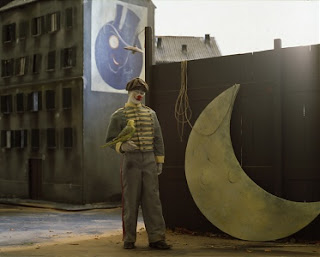
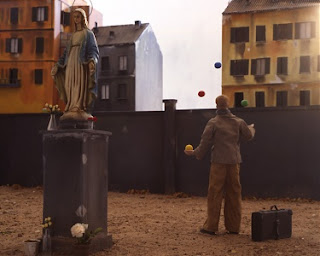
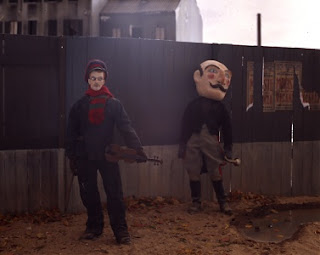
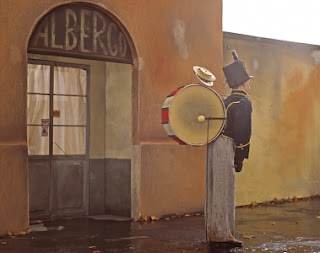
Paolo Ventura tells mysterious, uncertain, opaque, beguiling, vaguely unsettling tales...with photographs of emotionally precise figurines set within painstakingly made and highly evocative tableaus.

His dioramas of a small-time circus visiting an unnamed, gray northern Italian city--entitled Winter Stories--were on display in December and January at Hasted Hunt Kraeutler gallery (NYC). The day we visited it was appropriately bitter and overcast.

The Milan-born Ventura is a consummate craftsman, sketching out each scene first, then constructing the sets and dolls. Next he takes many preliminary pictures before deciding that the lighting and deployment are just right.

And Ventura is a conjurer of moods: the tristesse of wan light on dark walls, the soot-chill of urban winter. The occasional streak of color--a scarlet uniform, for instance--only highlights the umber and gray.

Above all, his people are alone, do not converse either with one another or with the viewer. Most of them stare past the viewer or have faces turned away from us, or are obscured altogether (under clown make-up or under a bird's-head mask or by a mass of balloons). The Italian verb imboscare applies: to hide (or be shut up) within the woods, to occlude, to lie in ambush. All we get are glimpses of secretive lives, seen from outside narrow, enclosed places. This is Fassbinder territory, that of "Eleanor Rigby."

For many more pictures, click here. For an excellent short video of Ventura explaining his technique, click here.

Friday, February 5, 2010

Dinosaurs in Color!


["An illustration showing the likely colors of Anchiornis huxleyi," credited to the National Geographic Society, appearing in New York Times article Feb. 4, 2010 by Carl Zimmer, "Evidence Builds on Color of Dinosaurs"-- for full article, click here.]

From the article: " 'We had a dream: to put colors on a dinosaur,' said Jakob Vinther, a graduate student at Yale."

Thursday, February 4, 2010

Interstitial Arts Foundation: Ellen Kushner Updates


The lobster and canary are members of the Interstitial Arts Foundation's Working Group. Today the IAF President, Ellen Kushner sent an update full of positive news:

"What an amazing, astonishing, record-breaking year 2009 was for the IAF! We published a second anthology, Interfictions 2, which inspired a successful auction of original art, held salons across the country, and much more . . .

Thanks to a terrific Executive Board and Working Group of vibrant, dedicated volunteers, the IAF achieved more in 2009 than ever before:

* Developed our new website.
* Established an active social media network, including over 1,100 Facebook members and hundreds of Twitter followers.
* Brought together artists of all types at interstitial salons across the U.S., from New York to Los Angeles to Maine.
* Published Interfictions 2, which was selected as one of the Best Books of 2009 by Amazon.com, and the online Annex.
* Brought the work of talented artists to the attention of the public through the Interfictions Auction.The IAF Salon & Reading in Second Life
* Hosted Interfictions 2 reading & music events in New York, Boston, Los Angeles, San Jose, and San Francisco.
* Hosted a groundbreaking virtual salon and Interfictions 2 reading in Second Life.

[...]

The IAF’s 2010 Wish List:

* Post regular news, reviews, events, and promotion of interstitial artists and their work.
* Establish a forum for interstitial artists to exchange ideas, collaborate, network, and brainstorm.
* Create an online art gallery.
* Feature guest bloggers on a regular basis.
* Organize an interstitial art symposium.
* Begin work on Interfictions 3.
*
Generate a wider engagement with the interstitial arts community through co-sponsored events with other artists & organizations.
* Hold more salons in towns across the U.S. & in Europe (Please visit our new How to Host an IAF Salon page!)

What would you like to see the IAF doing or promoting in 2010? What else can we do to make more of an impact, and to build a greater interstitial arts community?

Please visit the IAF's 2010 Wish List blog post where you can add your ideas to the mix!

Want to volunteer to help make something happen? Please contact us via the IAF website."

For more information on the IAF, click here.

Wednesday, February 3, 2010

Adele Sypesteyn


Alas that the lobster and canary could not swim/fly to New Orleans to see the exhibit of work by Adele Sypesteyn at the Soren Christensen Gallery in New Orleans.

Her paintings above are "Moving Quickly" and "First Moments."

We love her enigmatic landscapes, with their flourishes, curls and mutterings. She uses space very well, sending us on a search for balance, our mind flowing with the picture's energy. Like those laid down by Tapies and Twombly, her planes are flat but hint at immanence, capturing just behind the frame a presence from outside. Suggests to us what the source code for the primordial Garden might have looked like...

For more of her work, click here. For the gallery, click here.